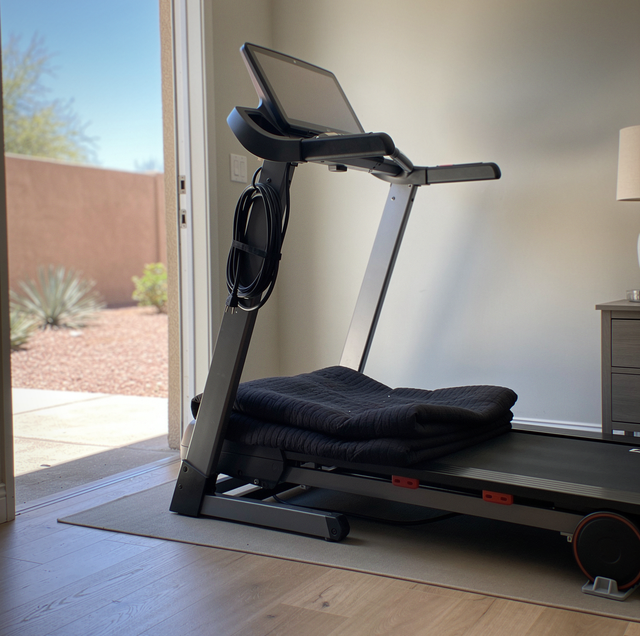
A treadmill carries a running belt under tension, an incline mechanism that can still move under its own power, and a console wired to the frame with cables long enough to snag on a doorway on the way out. A weight stack carries its own version of the same problem: a column of plates on guide rods that can slide and swing once the frame tilts. Tilt either one without addressing what is under tension first, and the belt can shift on its rollers, the console cable can pull loose at its connector, or the plates can shift on their rods and slam back down. Every machine in a home gym asks for the same sequence in a different order: find the part that is under tension, charged, or holding liquid, neutralize it, and only then move the frame.
The differences are worth setting out machine by machine before moving day, since a fix that protects a treadmill can do nothing for a cable machine or a rower.
| Machine | What Gets Locked, Removed, or Strapped |
|---|---|
| Folding treadmill | Power cord unplugged and coiled first; deck then locked upright with its safety pin or latch engaged |
| Non-folding treadmill | Console tilted forward or removed if it hinges; belt centered on the deck and the frame strapped flat to a dolly |
| Elliptical | Stabilizer bolts at the rear checked and snugged; front and rear handlebars removed on models where they unbolt |
| Rowing machine | Frame folded or split at its hinge; slide rail padded along its length; a water tank drained if the machine holds one |
| Weight stack/cable machine | Stack pinned at its resting position, loose plates removed if the pin will not hold them, cables slackened rather than left under stretch |
| Free weights and racks | Plates and dumbbells pulled off and boxed by weight; J-cups and safety bars unbolted from the uprights |
| Stationary bike | Pedals removed or taped flat, resistance knob backed off, seat post loosened to lower the overall height |
Measuring the Path and the Machine
Start with numbers, not muscle. Measure the machine's height, width, and length in its current state, then again for how it will travel: a folded treadmill deck standing on end is a different shape than the same treadmill lying flat on a dolly, and a power rack with its uprights still bolted together is taller than the same rack broken into panels. Write both sets of numbers down before anyone touches a bolt.
Then walk the route the machine will take on moving day, not the shortest one on a floor plan. Measure every doorway it passes, the width of any hallway turn, and the ceiling height over a stairwell if the machine is going up or down one. A treadmill deck, standing on end, is tall and narrow, and the diagonal across its face is still the number that determines whether it clears at an angle. If a rack, an elliptical, or a rowing machine's folded footprint is close to a doorway's clear width, plan on removing the door from its hinges before the machine ever leaves the room, rather than discovering the gap mid-carry.
Locking or Folding the Deck, Securing the Console and Cables
Unplug the treadmill before doing anything else to it. A folding deck that releases while the motor still has power, or a console that gets bumped while a cable is still live, turns a mechanical problem into an electrical one. Once it is unplugged, fold the deck to its upright position and confirm the safety pin or latch has fully engaged, since a deck that looks locked but is only resting against the latch can drop under its own weight the moment the frame tips.
Coil the console cable loosely and tape it flat against the frame instead of letting it hang, since a cable caught on a door frame during the carry can bend or snap the connector pin at either end.
A non-folding treadmill has no deck to lock, so the console becomes the point to protect: tilt it forward if the hinge allows, or remove it from its mounting posts where a simple release lets it lift free, and wrap the display face separately from the frame. Whichever type of treadmill you have, keep it traveling flat or upright on its wheels rather than laid on its side. Lying a treadmill on its side lets any lubricant on the deck or belt track pool unevenly and can pull the belt off center on its rollers, a problem that can go unnoticed until the machine is reassembled and running again.
Weight Stacks and Plates Travel Separately
A weight stack's cable is not built to carry a swinging load through a doorway; it is built to lift plates in a straight vertical line. Pin the stack at its lowest resting position before the machine moves at all, so the cable stays slack and the plates stay stacked rather than free to shift. On a machine where the pin will not hold every plate at once, the crew takes the loose plates off individually rather than leaving extras riding unsecured above the pin.
Free weights and a power rack follow the same idea from a different angle: strip every plate and dumbbell off before the frame moves, and take the J-cups and safety bars off the uprights. A loaded rack concentrates its weight at a few contact points and can pull out of square in a turn. An empty frame is lighter and holds its corners square through a doorway.
A rowing machine adds one more question: what is inside it? A water-resistant rower carries a tank that needs draining, or at minimum must travel upright with the tank secured, since a full tank adds sloshing weight that shifts during the carry. An air or magnetic rower has no tank to worry about.
Protecting Floors and Door Frames
Furniture sliders under a treadmill's wheels or a rack's feet let you reposition a heavy machine without dragging it across hardwood or tile, and they matter at the pivot points near a doorway, where a dragged corner gouges the floor. Cover the corners and leading edges of the frame in a moving blanket cinched with stretch wrap before it goes anywhere near a tight turn, since a bare steel corner meeting drywall or a wood jamb under load leaves a dent or a gouge in one pass.
On stairs, a gym machine's full weight shifts onto whoever holds the lower end, which is why a stair carry stays with the crew.
A treadmill or elliptical frame can become unpredictable on stairs if its balance shifts mid-carry, and a crew member below can be crushed against a wall before anyone reacts. Leave stair carries to a trained moving crew, not a DIY lift.
What the Crew Does and What You Prepare
Before the crew arrives, unplug every machine, strip loose plates off bars and racks, and set the smaller loose parts, pedals, bolts, and hand weights into a labeled box. Leave the weight stack itself for the crew.
From there, the physical carry is the crew's job. On a straight, flat path, one person guides the front of the machine while the others control its weight from behind, keeping the frame level rather than letting it tip forward or back. Through a doorway or a hallway turn, the crew treats the machine's folded shape the way they would any awkward, rigid load: they measure the arc it needs to swing through, not just the width of the opening, before committing the weight to the turn.
Setting It Back Up and Leveling It
At the new address, reverse the sequence rather than guessing at it. Unfold the deck and confirm the latch engages before letting go; reattach the console and route its cable as it left; and reinstall the pedals, handlebars, and safety bars in the order they came off. Re-pin a weight stack at its resting position before loading any plates back on, and check a power rack's uprights with a level before the first plate goes on a J-cup, since a rack standing on an uneven floor can rock and load one upright more than the other.
A treadmill deserves one more pass after it is plugged back in and leveled: run it briefly at a slow walking speed and watch the belt track its full length before stepping on it, so the deck and belt settle back into alignment on their own before the machine carries real weight again.
Frequently Asked Questions
Should the lubricant be drained off a treadmill belt before it moves?
No. On a treadmill that uses silicone lubricant, the silicone sits on the deck under the belt and stays there; there is nothing to drain. A deck that is dry before the move is worth lubricating at setup, not before the carry.
Can an elliptical stay fully assembled for a short move across town?
It depends on the model's arm linkage. Some ellipticals have handlebar arms that swing wide enough to catch a doorway frame even when the machine itself would clear, so measure the arms in their widest swing position, not just the base footprint, before deciding whether to leave it assembled.
What happens if a weight stack machine gets tilted without pinning the stack first?
An unpinned cable can jump out of its pulley groove when the stack shifts under a tilt, and a cable that has jumped the groove frays at the edge where it now rubs metal, a defect that is easy to miss until the machine is back in use and the cable fails under load.
Does a water rower need anything when it is refilled?
Refill it with clean water to the level mark on the tank and add the purification tablet the rower uses, since standing water in a tank that was drained and refilled can grow algae without it.
Do rubber gym floor mats move with the equipment?
They go last onto the truck and first off it, since the machines stand on them at the new address. A thick rubber stall mat is heavy and bends when lifted, so it travels rolled or stacked flat as its own item rather than being slid under a machine.
Should the treadmill's safety key travel with the machine?
Pack it in the labeled parts box. A home treadmill with a safety key will not start without it, and a key left in the console slot can snap off or go missing during transport.
Hand your gym equipment teardown to movers who lock the deck, pin the stack, and label every bolt for reassembly — the machine goes back together in the order it came apart. Aardvark Movers serves Phoenix and the Valley. Call (602) 716-5555.


