
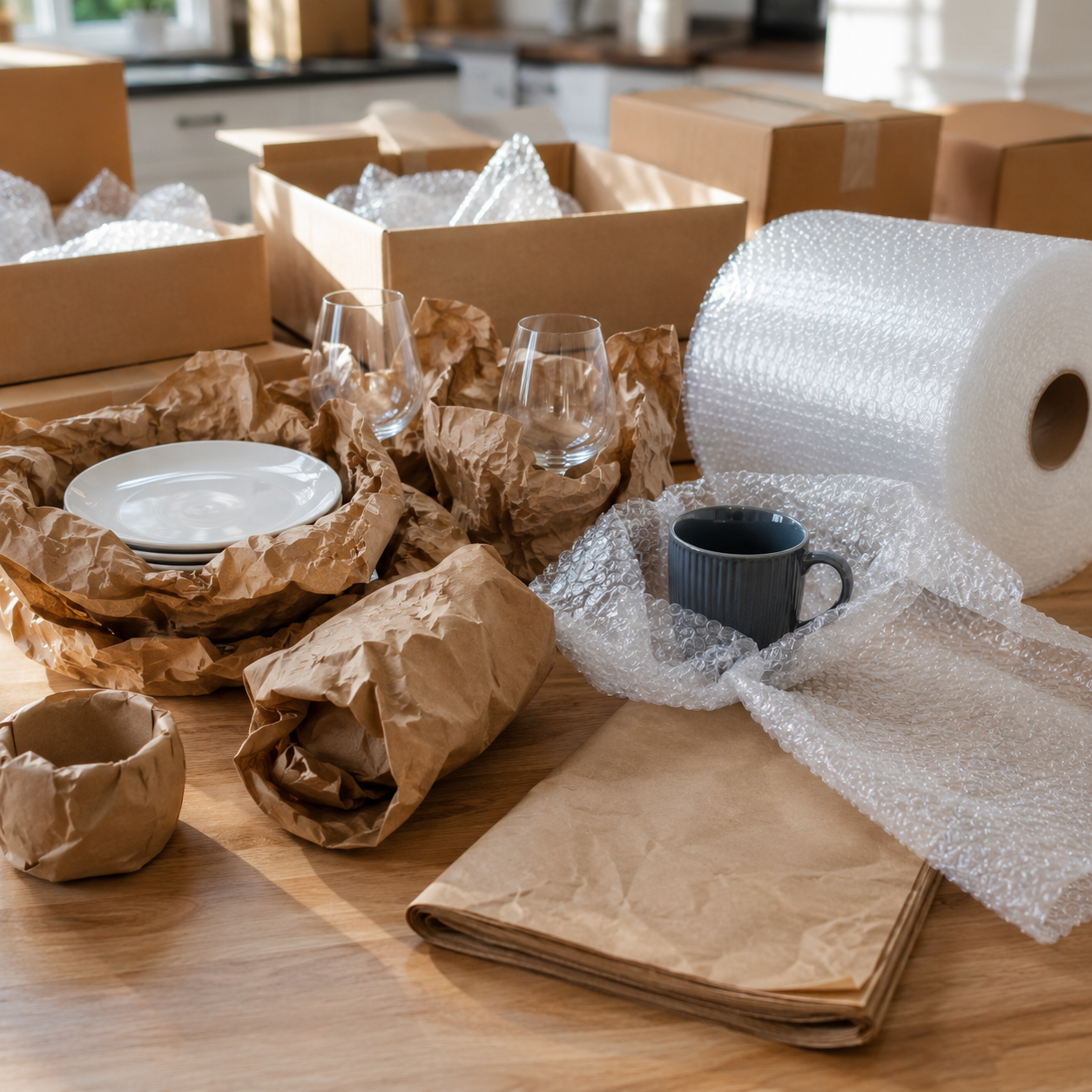
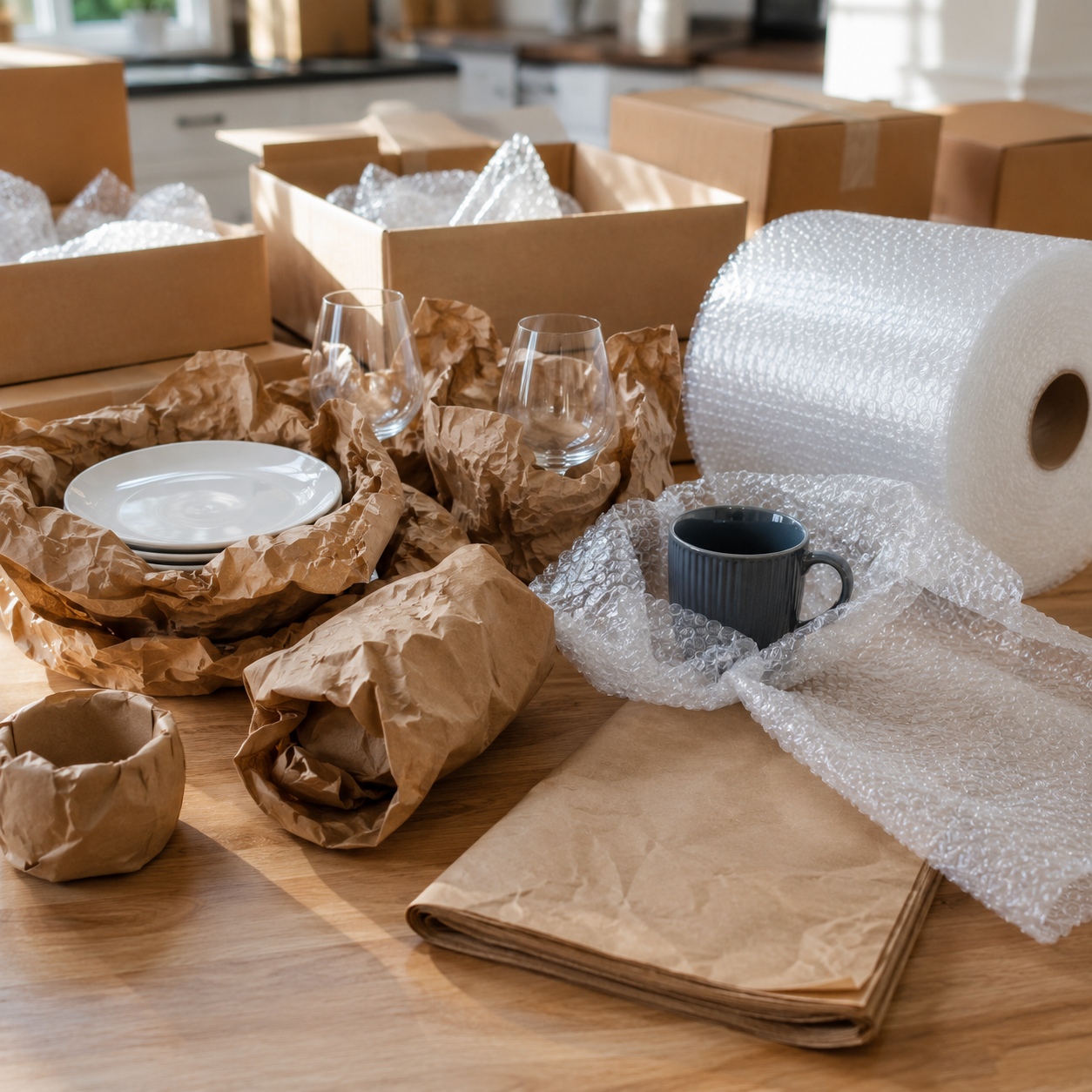
You are standing in the moving-supply aisle with a cart, a stack of fragile things at home, and two choices staring back at you: a fat roll of bubble wrap or a brick of plain packing paper. Grab the wrong one for the job, and you either waste a roll of plastic on things that do not need it or leave something delicate with too little protection.
They do two different jobs, though. Once you know how each one actually protects an item, the choice stops being a coin flip.
How Each One Protects
Packing paper protects in two ways. Crumpled, it fills space and cushions with the give of the paper itself. Wrapped around an object, it puts a clean, ink-free layer between surfaces so nothing scratches, scuffs, or transfers dirt. It molds to odd shapes, tucks into hollows, and disappears into the recycling at the other end.
Bubble wrap protects by trapping air. Each pocket is a tiny shock absorber, and a wrapped item essentially floats inside a cushion of sealed bubbles that flatten on impact, spreading the force out rather than letting it land on the glass. That air layer is what makes bubble wrap a better shield against a real drop or a hard stop, and it is why the most fragile, most irreplaceable items earn a wrap of it.
Where Each One Wins
Reach for packing paper when you are wrapping dishes, filling the gaps in a box, nesting glasses, protecting surfaces from scratches, or cushioning anything sturdy enough that surface protection matters more than shock absorption. It is compact, so a single pack wraps a whole kitchen, and it will not slide the way plastic can.
Reach for bubble wrap when the item is truly breakable, and the cost of failure is high: electronics, framed art and glass, ceramics and collectibles, lamp bases, anything with a screen. The trade-off is bulk. Bubble wrap eats box space and roll length fast, so using it on everything is wasteful. Using it where a drop would be a disaster is smart.
| Factor | Packing paper | Bubble wrap |
|---|---|---|
| How it protects | Cushions by crumpling, prevents scratches | Traps air pockets that absorb impact |
| Best for | Dishes, gap-fill, surface protection, sturdy items | Electronics, glass, art, fragile collectibles |
| Space used | Compact, wraps a lot per pack | Bulky, fills boxes fast |
| Leaves residue | Ink-free varieties leave none | None, but not breathable long-term |
| Reusable | Recyclable, single use | Reusable several times |
The Best Answer Is Often Both
Professional packers rarely choose one and abandon the other, because the strongest protection layers them. Wrap a fragile item in a sheet of paper first, so the surface is covered and the bubbles never press directly on the finish. Then add bubble wrap over that for shock absorption and fill the box around it with crumpled paper so nothing shifts. Paper for the surface, bubbles for the blow, paper again for the void. That combination is what carries the pieces you cannot replace. Think of it as layered armor: the paper is the shirt, the bubble wrap is the padding, and the crumpled fill around the box is the seatbelt that keeps everything from shifting on the road.
Wrap items with the bubble side facing in, toward the object. The flat side out lets tape grip cleanly, and the bubbles cradle the surface instead of leaving faint pressure marks on a glossy finish.
One Hot-Weather Consideration
Heat changes the math for a couple of items. In a hot climate, a closed truck can pass 140 degrees inside in summer, and bubble wrap pressed tight against vinyl records, candles, or certain plastics can trap that heat and leave an imprint on a softened surface. For heat-sensitive belongings, a paper wrap breathes better, and the real fix is to keep those items in a cooled vehicle rather than in a baking cargo box. For ordinary glass and ceramics, heat is not an issue, and the choice comes down to protection alone.
What About Packing Peanuts and Foam
The aisle offers a third option worth a word: loose-fill peanuts and foam sheets. Peanuts do one job well, filling the empty space around an already-wrapped item so it cannot shift inside the box, and they flow into odd gaps that paper cannot reach. What they do not do is protect a surface or cushion a direct hit, so they belong around a wrapped item, never against a bare one. Foam sheets sit between paper and bubble wrap: soft, thin, and clean, they work for stacking between plates or guarding a finish without bulk. None of these replaces the paper-then-bubble method for your most fragile pieces. They are supporting players that fill voids and add a layer, not the main line of defense. One caution with peanuts in a hot garage: they cling to everything with static and scatter the moment a box tips, so many crews skip them in favor of cleaner paper and foam.
Frequently Asked Questions
Is bubble wrap always better than packing paper?
No. Bubble wrap is better at absorbing a hard impact, which matters for electronics and glass, but packing paper is better for surface protection, filling gaps, and wrapping sturdy items in bulk. Using bubble wrap on everything wastes space and money. Match the material to the risk.
Can I pack fragile items with only packing paper?
For moderately fragile items like everyday dishes, yes, if you use enough of it and pack the box tightly. Two layers of paper per plate, packed on edge with all gaps filled, protect dishes well. For high-value or highly breakable items, add bubble wrap for the extra shock absorption.
Which one saves more room in the truck?
Packing paper, by a wide margin. It compresses around items and fills space efficiently, while bubble wrap adds loft and takes up volume. If box count and truck space are tight, lean on paper and reserve bubble wrap for the few items that truly need it.
Does newspaper work instead of packing paper?
It works in a pinch for gap-filling, but the ink rubs off onto dishes, glass, and light-colored items, leaving a mess you have to wash off later. Blank newsprint or packing paper avoids that. If you use newspaper, keep it away from anything porous or white.
How many layers of bubble wrap do I need?
For most fragile items, two to three layers over the whole surface, with extra attention to corners and protruding parts. The goal is for you to not feel the hard object through the wrap when you press on it. More than that is usually overkill and just wastes the roll.
Can I reuse bubble wrap and paper after the move?
Bubble wrap can be reused several times as long as the bubbles are still intact, so save it. Packing paper is more of a single-use material once it is crumpled, but it recycles cleanly. Flatten and keep any bubble wrap that survives for the next time you ship or store something.
Match the Material to the Risk
Neither material wins outright because they are not really competing. Packing paper wraps surfaces, fills voids, and handles the bulk of the kitchen. Bubble wrap floats the few items where a single drop would be heartbreaking. Use paper widely, use bubble wrap deliberately, and layer both around anything precious, and everything you own arrives the way it left.
If you would rather not learn the difference by trial and error, let a crew that packs for a living handle the fragile boxes. Aardvark Movers offers full and partial packing across Phoenix and the Valley, with the right materials and no hidden fees. Call (602) 716-5555 for a free quote..


