
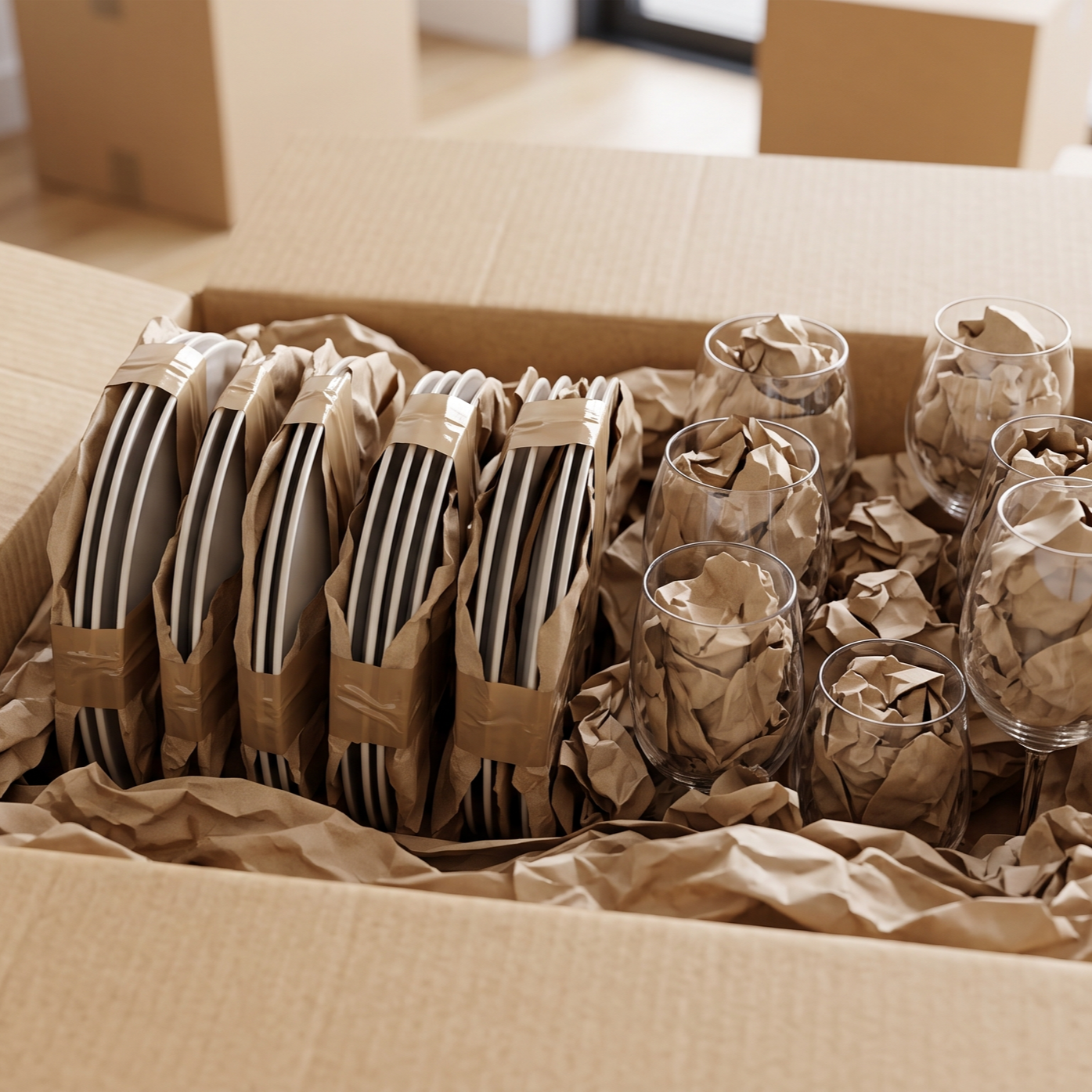
There is a specific sound no one wants to hear when they open the first kitchen box in the new place. It is the soft clink of ceramic pieces sliding against each other, the sound of a stack of plates that did not make it. By then, it is too late, and the fix takes only a few minutes if done right the first time.
Dishes and glasses break in transit for reasons unrelated to luck. Get the orientation, the cushioning, and the box weight right, and a plate is far tougher than it looks.
Why Plates Crack and Glasses Shatter
A plate is strongest across its face and weakest flat. Stack plates the way they sit in your cupboard, lying flat on top of each other, and every bump in the road drives the whole stack down onto the bottom plate. The load piles up and the lowest plate cracks first, then the next. Turn those same plates on edge, standing vertically like records in a crate, and each one carries the shock through its strongest direction instead of its weakest.
Glasses fail differently. They are hollow and thin-walled, so they crush inward when something presses on the rim or the side. The empty space inside is the enemy. Fill it and pad the outside, and a glass that would shatter loose will ride safely.
Wrap Each Piece, Then Stand It on Edge
Start with a box whose bottom you have cushioned with a thick layer of crumpled packing paper. Wrap each plate individually in two sheets of paper, then bundle three or four wrapped plates together and set the bundle into the box on its edge, standing upright, never flat. Packed vertically, the plates brace one another, and no bottom plate bears the whole stack's weight.
Glasses and stemware get wrapped from the rim down, with a twist of paper stuffed inside first to support the hollow. Set them upright in the box, the heavier tumblers on the bottom row and the delicate stemware on top. Nestle paper between every piece so nothing touches its neighbor directly. Glass against glass is where cracks start.
A dish-pack or dish-barrel box with cell dividers is worth using for a full set. The dividers keep every glass in its own compartment so a hard stop cannot knock them together, which is the single most common way a box of glasses turns into a box of shards.
Fill Every Gap and Keep the Box Light
Once the box is packed, there should be no empty space anywhere. Top it off with crumpled paper until you can close the flaps and feel no shifting when you gently rock the box. Movement is what breaks things. A tightly filled box has none.
Weight matters too. It is tempting to fill one big box with all the kitchenware, but a heavy box invites a dropped corner and puts more mass behind every piece when it stops short. Keep dish boxes small and within a manageable weight, label them “fragile” on the top and sides, and mark which way is up so they never get stacked upside down or buried under something heavy.
A Note for Hot-Weather Moves
Summer heat adds a wrinkle for a few kitchen items. Candles tucked in with the dishes will soften and smear in a truck that tops 140 degrees inside, and certain plastics and sealed containers can warp. Keep anything heat-sensitive out of the dish boxes and moved separately in a cooled vehicle. The plates themselves do not mind the heat, but their box-mates might.
Where Dish Boxes Ride, and How They Get There
How a box is packed only matters if it is carried and loaded to match. A dish box should be small enough that its weight stays manageable, because a heavy box is the one that earns a dropped corner. Carry it from the bottom, never by the flaps, and set it down flat rather than sliding it. In the truck, dish boxes belong low and stable, resting on a solid flat surface, never at the bottom of a tall stack where everything above presses down on them, and never perched where they can tip. Mark them fragile on the top and all four sides and draw an arrow showing which way is up, so no one loads them upside down or buries them under a dresser.
Nest the Bowls and Odd Shapes
Plates and glasses get the attention, but bowls, mugs, and serving pieces break just as easily when they are packed carelessly. Bowls nest a few at a time with a sheet of paper between each one, then get wrapped as a bundle and set into the box on edge like plates. Mugs take a twist of paper inside and a wrap around the handle, which is the part that snaps first. Awkward pieces like a gravy boat or a teapot need paper packed into every hollow and around every spout so nothing has room to flex. The rule holds across all of them: support the weak points, fill the empty space, and never let one piece rest bare against another.
Frequently Asked Questions
Do I really have to wrap every single plate?
Yes, if you want them all to arrive. Individual wrapping keeps each plate from grinding against the next, which is where chips and cracks begin. It feels slow, but a wrapped plate standing on edge is close to bombproof, and the few minutes per plate is cheaper than replacing a set.
Can I use towels and linens instead of packing paper?
You can, and it doubles as a way to move your linens. Dish towels and cloth napkins work well between plates and around glasses. Just make sure every gap is still filled and nothing can shift, since a soft wrap with room to move still lets pieces knock together.
Why pack plates on their edge instead of flat?
Because a plate is strongest across its edge and weakest through its flat face. Standing them vertically means each plate absorbs road shock through its strong direction, and no single plate carries the weight of the stack above it. Flat-stacked plates crush from the bottom up.
How full should a box of dishes be?
Full enough that nothing moves. Cushion the bottom, pack the pieces snugly, and fill the top with paper until the flaps close against slight resistance and a gentle shake produces no rattle. Empty space is where breakage happens.
What is the safest way to pack wine glasses and stemware?
Wrap each one from the rim down after stuffing a twist of paper into the bowl to support it. Stand them upright in a cell-divided box if you have one, delicate pieces on top. The stem is the weak point, so it should never bear weight or press against anything hard.
Should glasses go on the bottom or the top of the box?
Heavier tumblers and mugs go on the bottom, lighter and more delicate glasses and stemware on top. Stacking a heavy mug on a thin wine glass is a quick way to crush it. Build the box from sturdy to fragile as you go up.
A Quiet Box Is a Box That Made It
The clink you do not want to hear is entirely preventable. Stand plates on edge so their strong direction takes the shock, fill and pad every glass so nothing crushes inward, kill all the space, and keep the boxes small and clearly marked. Do that, and opening the kitchen boxes becomes the easy part of settling in.
If the thought of wrapping every plate makes you want to skip it, let someone do it right. Aardvark Movers offers full and partial packing for kitchens, fragile items, and whole households across Phoenix and the Valley, with no nickel-and-diming. Call (602) 716-5555 for a free quote.


