
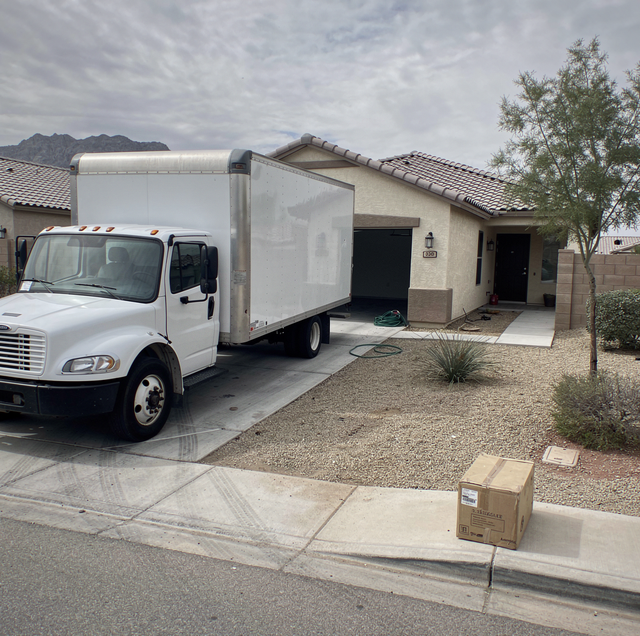
Does the truck at your curb on loading day arrive at the new address with everything still on board? Across town, that is the whole job. On a move of a thousand miles, it can go either way, and the version where your things change vehicles partway is an ordinary one rather than a sign that something went wrong.
There is a physical reason behind all that. A truck built to work a residential street and a trailer built to run between states are not the same machine, and the one you can park in front of a house is a poor fit for a highway. Whether your load stays on one vehicle or moves across to another changes your calendar more than anything else.
450 Miles Sends a Load Onto a Different Class of Truck
Federal trucking definitions draw the line at 450 miles. Anything under that is a short haul, generally performed with straight trucks, and anything over it a long haul, generally performed with tractor-trailers. Distance does nothing to your furniture on its own. What it changes is which class of vehicle a carrier can commit to one household for days.
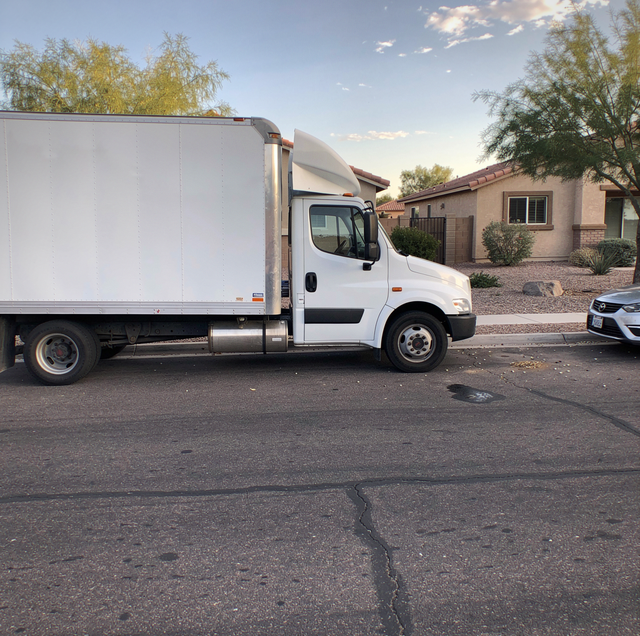
A straight truck is the vehicle you would picture: one cab and one body on one frame, the kind that fits a driveway. Federal definitions put it at roughly half the size and capacity of a tractor-trailer. The long-haul equivalent has its own name: the road van, a tractor pulling a trailer that can be dropped and swapped while the tractor works elsewhere.
That combination is awkward where you live, and the dimensions are published. Highway engineers design intersections around a design vehicle known as the WB-67 interstate semitrailer, 73.5 feet long overall with a minimum design turning radius of 45 feet. A cul-de-sac with cars parked along both curbs offers none of that.
So the work gets split. One vehicle that can reach your door handles the part of the trip that happens at a house, and one built for distance handles the part in between.
Between the Straight Truck and the Road Van
The handoff has a place, and it is not your driveway. It happens at a terminal the carrier operates, at a dock built to work from with room outside to swing a trailer.
What happens on that dock is a rebuild of the load. A road van is loaded in the order it will be emptied, rather than the order things arrive at the door, so your section of the trailer goes in at a position that matches where your address falls on the route. Cartons arrive in groups, and furniture is re-tiered against the trailer walls. The driver who takes it out signs for the whole trailer before it moves. None of that is visible from your side, and none of it needs you. What you feel later is the consequence: from the moment the load leaves your street, where it sits in the trailer is already an answer to a question about another address.
How Many Loads Ride on a Road Van at Once?
More than yours, and the moving paperwork says so sideways. Federal disclosure rules for household moves that cross a state line tell a household asking to shift its dates that a mover will generally agree if the change does not delay its equipment or interfere with another customer's move. The other customer in that sentence is on the trailer, or waiting on it.
A road van's route exists before your load is on it. The trailer leaves with a sequence of addresses to reach, each one attached to a different household, and the order they come off follows the road rather than the order they went on. Your pickup day fixes where you enter that sequence; where you come off it is a separate question, with other driveways involved.
For you, this shows up on the calendar and nowhere else. A trailer dedicated to one household has to wait until that household can fill it, while a trailer carrying several can run loaded and keep running. What a household gives up in exchange is precision about the day its things arrive, and that trade is made at booking.
Moves That Never Change Vehicles at All
A long trip can stay on one vehicle from door to door, and the 450-mile line is the first place to look. A move under it is a short haul under federal definitions, generally performed with a straight truck, one vehicle at both ends of your move, though tractor-trailers often handle large short hauls too.
Size is the other lever. A household with enough in it to occupy a trailer on its own has no reason to share one, and a carrier has no reason to route it through a terminal on the way, so the load goes on at your house and comes off at the new one. Below that, sharing keeps a trailer from running half empty across several states.
Dates can also be pinned down by agreement, and federal rules define that arrangement as a guaranteed pickup and delivery service, an additional level of service featuring guaranteed dates. It is a different agreement, not a different truck. It changes what the carrier owes you about timing, while the vehicle chain underneath stays exactly as it was.
A Range of Dates Rather Than a Delivery Day
Twenty-four hours is the number to hold onto. Federal disclosure rules say a mover will usually give 24-hour advance notice before arriving with a shipment, and that call turns a range of dates into a day you can plan around. Until that call comes, the commitment written down is not yet a single date. For non-guaranteed service, the bill of lading specifies an agreed date or period for pickup and an agreed date or period for delivery, and movers call the latter the delivery spread.
The spread is the trailer's schedule written as yours, and it covers a route the carrier is still assembling at the time you sign. The addresses ahead of yours have their own stairs and their own people, who may not be ready when the trailer reaches them, and a day lost at any one of them sets every address behind it back. A long move names a window where a local one names an hour, and the difference has nothing to do with how careful the crew is.
You get one real lever here, and you pull it before anything is loaded. The pickup day and the delivery period go on the bill of lading together, both agreed with you in advance, so the days you truly cannot be reached go into that conversation instead of a phone call from a driver who is already an hour out. Read both date lines before you sign anything, and you will know whether you are waiting on a day or on a stretch of them.
Frequently Asked Questions
How do you find out before moving day whether your load will change trucks?
Ask during the survey, the walk-through where a mover looks at what is going, which can be done on-site or virtually. Put the vehicle question in that conversation, because you will not get a better one. Your paperwork also includes the identification number of the vehicle or vehicles that will transport the shipment, so a planned second one is recorded before you load.
When does the destination end of the move get organized?
Before the trailer is anywhere near it. A destination agent is designated in the arrival area to help you or the driver once the shipment is close, and that assignment happens at booking rather than on the road. Federal guidance also places being available at pickup and delivery on a customer's own list of responsibilities, which serves as a scheduling instruction: someone you trust must be at the arrival address on the day the trailer actually arrives.
Who is the van operator, and did that person load the truck?
Not necessarily. The term van operator refers to whoever drives the vehicle carrying your household goods; on a long move, that's the person with the trailer, rather than the crew who carried your sofa down your steps. The crew at the house may work for a local company acting on behalf of a national carrier. Knowing which is which tells you who to call about the load and who about the day.
Can part of a shipment travel on a second vehicle?
Yes, and there is a term for it: overflow, articles left behind because there was not enough space on a van, to be loaded on a second van for transportation and delivery. It is a space problem, and it can happen on a move of any length. The practical effect is that your two portions can arrive on separate days, which is worth raising if your survey showed the van filling to its back doors.
Does changing your pickup date also affect the delivery dates?
Usually, and federal disclosure rules explain why: most movers will agree to a date change if it will not cause unreasonable delay to their equipment or interfere with another customer's move. Your new pickup slot has to fit into an existing route, so your delivery period can shift by more days than the pickup did. Ask for the revised period in writing when you agree the new day.
Will you get a written list of what went on the truck?
Yes, and it is worth knowing what it is for: an inventory prepared as the load goes on, each piece numbered, any damage noted beside it, signed by you and the mover, and copied to you. At delivery, that copy is what you check the pieces against as they come off, and anything missing goes on the form before you sign the mover's copy.
A long-distance date is easier to hold when the vehicle plan behind it is worked out early — a pickup day and the delivery period that follows are booked against equipment that is already carrying other households. Aardvark Movers serves Phoenix and the Valley. Call (602) 716-5555.


