
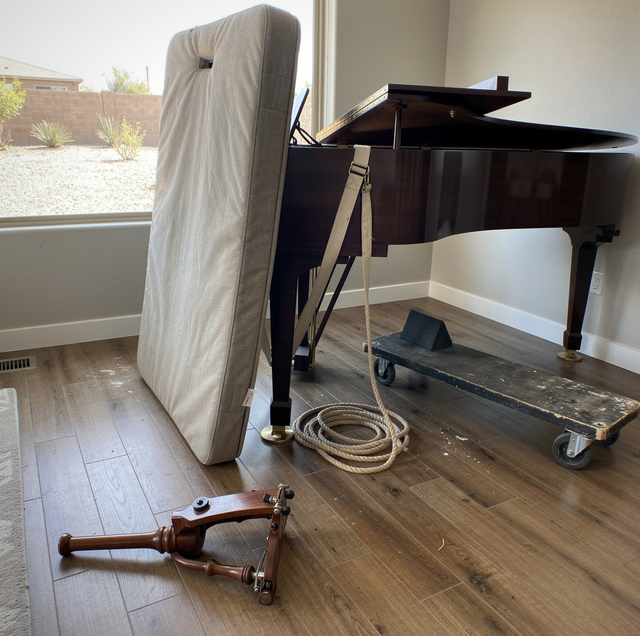
Most people picture a piano move as a lifting problem. A grand is not really a lifting problem. It is a sequencing problem. A large, rigid, oddly balanced object has to end up lying against a padded board, on its edge, in an order that never asks any single part to hold weight it was not built to hold. Done in the right order, the whole thing is slow and dull, which is what a good piano move looks like. Done a step out of order, several hundred pounds of iron and wood get to find out which part was holding it up.
QUICK ANSWER: A grand moves on its edge, on a padded board. The board is stood against the bass side first, the lyre comes off, the piano is tilted onto it, and the legs come off one at a time as it lands.
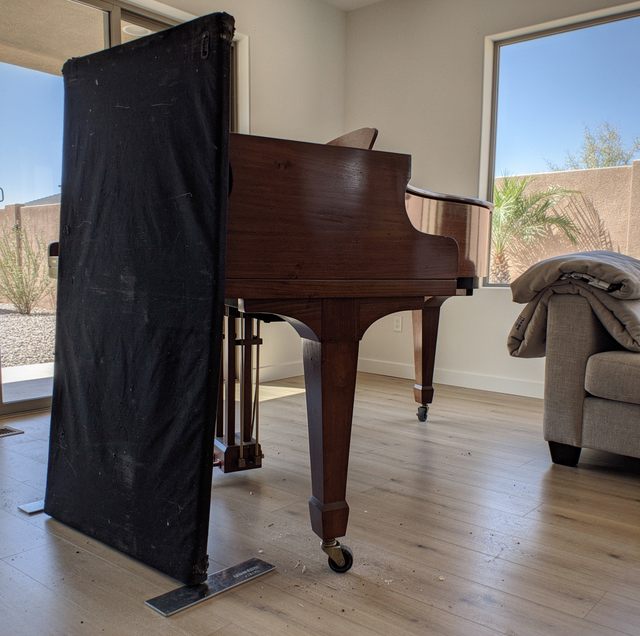
Why a Grand Rides on Its Edge at All
An upright and a grand get handled differently for one reason, and it is not size. It is where the weight sits. Lift out the upper front panel of an upright, since the back of most uprights is an open-posted frame rather than a removable cover, and the mass is right there at eye level: the cast-iron plate, the pinblock, and the strings, all stacked high over a narrow base. That is why an upright's entire move is a study in avoiding tipping.
A grand carries its mass low, but not centered. The weight sits forward, over the keyboard end where the plate is heaviest, and the pinblock lives, with the tail comparatively light. Standing on its own three legs on a level floor, a grand shrugs off an ordinary bump without complaint. That stability vanishes the instant the case leans. Once it is tilted, the forward imbalance takes over faster than a person can correct, which is why putting a grand on its side is a controlled crew maneuver against a waiting board, never a shove.
Under the strings of either instrument sits a single cast iron plate, and on a full grand it is holding the combined pull of the strings at roughly twenty tons, something near forty thousand pounds gathered inside a wooden case. That load is what makes a piano rigid and unforgiving, unlike furniture. A shock has nowhere to go except into the soundboard, the pinblock, and the plate, which is why every step below is built around supporting the case rather than raw strength.
The Board Comes Up Before Anything Comes Off
The padded piano board is in position before a single fastener is touched. It is stood on edge against the bass side of the case, the long, heavier side that carries the low strings and the widest section of the plate, and blocked so it cannot slide out from under the piano. Everything that follows is arranged so the case only ever has to travel a few inches to meet a surface that is already there and already supported. Resting on that board, held along its full length, is a different thing from a piano tipped onto its side with nothing behind it.
The lid gets closed and latched, then the music desk comes out. On a grand, the desk is not hinged, whatever the reader may remember from an upright at home; it slides in a track and lifts straight out, and it comes off early because it is thin, decorative, and directly in the way. The lid itself is unhinged and carried off separately, wrapped on its own.
The fallboard closes over the keys and gets padded, and that padding is not cosmetic. A knock on an exposed key does not stop at the key. It shoves the whole train of small wooden and felt parts behind it, the capstan, the wippen, the jack, and the hammer assembly, out of position. The result is a note that sticks or goes silent while playing, and nothing at all looks wrong from the outside.
The Order the Legs Actually Come Off
What follows is written so you can recognize whether it is happening in your own living room, not so you can run it. A grand comes down with trained hands on it at every second, and there is no version of this that a few strong friends should be attempting.
With the board standing against the bass side, the pedal lyre comes off next: the wooden column and pedal assembly hanging under the keyboard. It has to be clear before the case moves at all, because it is the first thing a tilting piano would crush against the floor.
Then the crew tilts the case toward the board, supporting the weight by hand and by strapping the entire way. The bass-side leg comes off during that descent, in the moment when the board is taking the load, and the leg is not. This is the step people get backward, and it is worth being clear about: all three legs cannot come off first, and then the piano be lowered, because nothing would be holding it up. The legs leave one at a time, each one released only after something else is carrying what it was carrying.
WARNING: Most piano injuries happen during the tilt or on stairs, not during a lift. A leg released a beat too early drops several hundred pounds onto whoever is closest. Never attempt this with fewer than four trained movers.
Once the case is resting on the board and strapped, the remaining two legs come off with the piano fully supported and no sideways load anywhere near the joints. Straps then run across the board and the case together, and from there the piano travels the way a large sheet of plywood does: on its edge, guided rather than carried, with the weight riding on the board's wheels instead of on anybody's back. The legs are the part a technician most often finds loosened weeks after a bad move, which is precisely why they come off before the case ever travels sideways and go back on only after it is standing again.
What a Rigid Board Does to the Route
The measurement that matters changes the moment the piano is on the board. At rest, a grand is measured at its widest point, and that is the number most people are told to worry about. On edge and strapped down, that width is no longer the binding constraint. What binds is the room the rigid assembly needs in order to change direction.
A piano board does not flex, and it does not shorten. It pivots. A hallway wide enough to hold the board standing still is not automatically wide enough to turn it, because a turn needs room for the tail to sweep through an arc while the keyboard end holds the pivot point. A stair landing can measure perfectly well on a tape and still be the exact spot where a move stalls, since the board has to complete its rotation inside that landing before it can start down the next flight. Crews plan turns as arcs, not as widths.
Two related things change with the piano on edge. The case's width becomes its height, so overhead clearance at stair soffits, low doorways, and light fixtures becomes a real number to check rather than an afterthought. And a doorway that a board clears going straight through is a different problem from the same doorway approached at an angle, which is the situation at nearly every turn into a room. Both ends of the move get walked and measured, not just the address the piano is leaving.
Where All That Weight Actually Lands
Sitting on its own legs and casters, a grand spreads its load over three points and mostly stays put. Strapped to a board, that same load transfers to the board's wheels or skid edges, and the contact patch under the whole assembly shrinks to a few square inches of hard rubber or steel.
TIP: A loaded piano board puts well over eight hundred pounds onto four small contact points. Ask whether a deck, porch, or older interior staircase was built for a concentrated point load, not just for foot traffic, before moving day.
That concentration is what makes floors part of the plan. Hardwood, tile, gravel, and a wood deck each behave differently under it, and a surface rated comfortably for people standing on it is not automatically rated for the same weight on four small wheels. Older stair treads deserve particular attention, since a board being walked down a flight loads one or two treads at a time rather than spreading itself out. A door threshold of an inch is enough to catch a skid edge and stop a board dead, or to start a lean nobody wanted, which is why crews ramp or plate the awkward transitions rather than muscling through them.
Two Kinds of Settling, on Two Different Clocks
A piano is not finished adjusting when the truck pulls away, and the two things it is adjusting to do not run on the same schedule.
Temperature is the fast one. A piano brought from a hot truck into a cooled room is out of thermal balance for hours, not weeks. The cast iron plate and the wooden case change dimension at different rates as they equalize, and string tension moves along with them, which is why a piano can read badly out of tune on delivery afternoon and noticeably better the next morning. Crews close the case and let it come to room temperature on its own before it is played hard.
Humidity is the slow one. Wood takes up and releases moisture over weeks, and the soundboard's crown, the slight upward curve that holds pressure against the strings, rises and falls as it does. A room that runs drier or damper than the last one will keep moving the piano for a month before it settles. That is the clock a tuning has to wait out, because a fine tuning laid onto wood that is still moving will not hold. Many technicians will do a rough pitch correction on delivery day and book the real tuning for a follow-up visit once both clocks have run out.
Frequently Asked Questions
Why does a grand come down on its bass side rather than the treble side?
The bass side is the long, straight side of the case, and it carries the heaviest section of the plate. Laying the piano against it means the board supports a flat, continuous run of the rim rather than the curved treble side, which would contact the board at only a few points and concentrate the load there.
Does the lid have to come off, or can it just stay closed?
It comes off. A closed lid is still hinged, and hinges are decorative hardware that will take load in a tilt they were never meant to take. Removing it also drops several inches off the assembly's height once the piano is on edge, which is often the difference at a low stair soffit.
How much room does a piano board actually need to make a turn?
More than its width. Because the board is rigid, the tail has to swing through an arc while the keyboard end pivots, so the usable space is measured diagonally across the landing or hallway junction rather than wall-to-wall. A turn that a tape measure passes can still be a turn the board cannot complete.
Will a residential lift take a grand piano on a board?
Often not. Passenger lifts in homes and small buildings are commonly rated somewhere between 750 and 1,000 pounds, and that rating covers the piano, the board, and every person riding along. A grand and its board can spend most of that allowance before a single mover steps on, which is what sends crews to a freight lift or the stairs.
Which settles first after a move, temperature or humidity?
Temperature, by a wide margin. Thermal equalization between the iron plate and the wooden case takes hours to a day, while moisture exchange between the soundboard and the case takes weeks. A piano that sounds wrong on the delivery evening is usually still thermally moving, and it is not a fair sample of how the tuning actually held.
Does the keyboard end or the tail go through the doorway first?
Usually the tail. The narrow end leads so the crew can see and steer the widest part of the case through last, with the pivot already established inside the room. On a tight approach, the crew may reverse it deliberately, which is a call made at the doorway with hands on the board, not planned from a floor plan.
Book a crew that brings the board up before it touches the piano — the right order, the right straps, and a route measured for the turn instead of just the doorway. Aardvark Movers serves Phoenix and the Valley. Call (602) 716-5555.


