
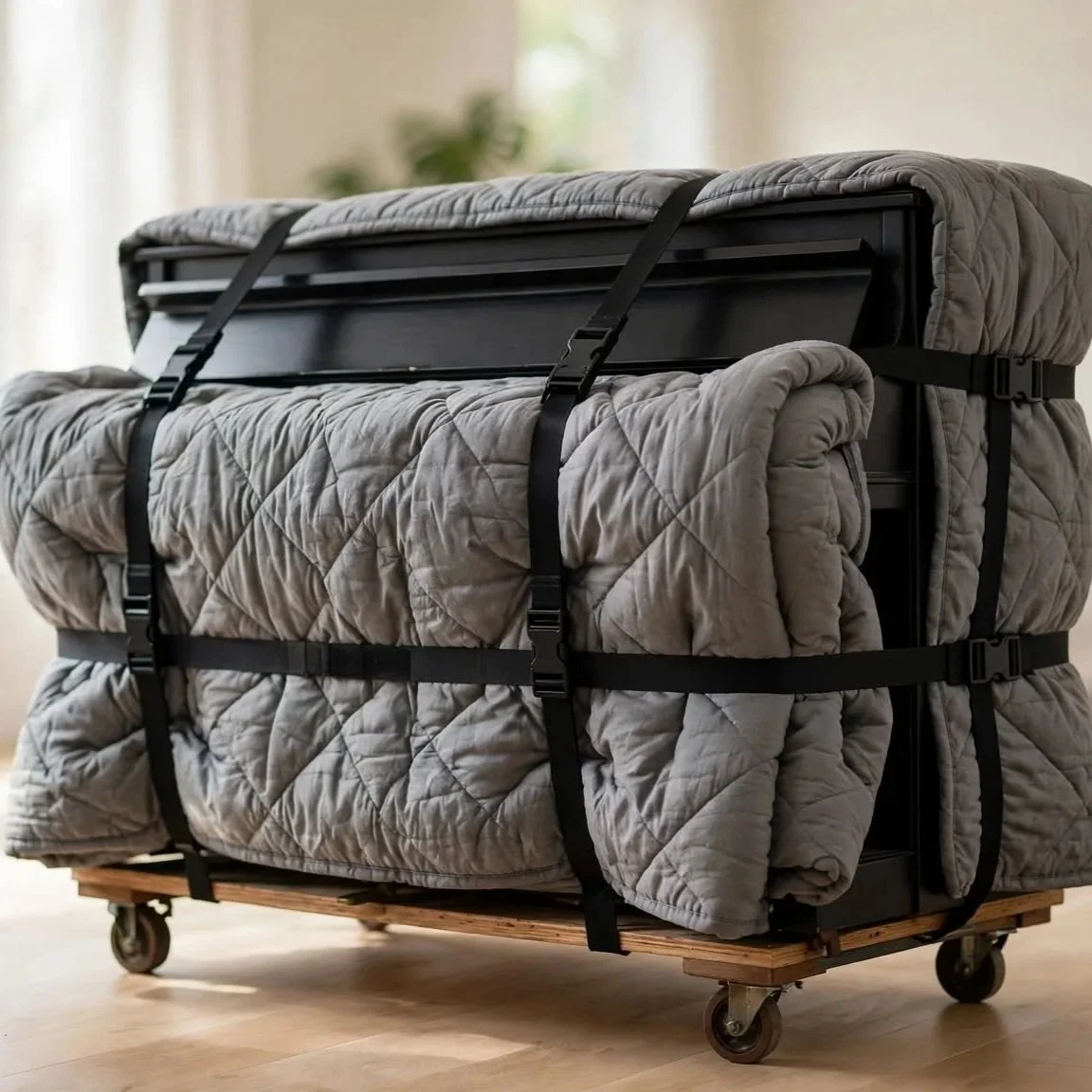
A piano rarely announces the moment it becomes too much for a few friends and a rented dolly. It sits in the same corner of the living room for a decade, gets played maybe twice a year, and then a move comes up. Most people size up the job the way they would a couch: how heavy does it look, how many stairs, how many hands do we have. That comparison is where the trouble starts, because a piano is not a heavy piece of furniture. It is a precision instrument built around thousands of moving parts, and the way it carries its own weight has almost nothing in common with a sofa or a bookcase.
QUICK ANSWER: Call professional movers if the piano is a grand or baby grand of any size, if the route includes more than three or four stairs, if any doorway or turn is narrower than the piano's widest point, if the move covers more than a short single-floor distance, or if you cannot answer what a piano board and a rated dolly are. An upright piano moving across a level room with no steps and a wide, clear path is the one scenario in which a careful, well-staffed DIY move is sometimes reasonable.
Why a Piano Moves Differently Than Furniture
A dresser or a sofa spreads its weight across a wide base and tolerates being tilted, dragged, or set down at an angle without any real consequence beyond a scuffed leg. A piano does the opposite. Nearly all of its weight sits over a small footprint, concentrated in a cast iron frame (called the plate or harp) that anchors the strings under tremendous tension, sometimes the combined pull of twenty tons or more across all the strings at once. That plate rests on a wooden case built for stability, sitting still, not for absorbing shocks or shifting angles in transit.
The other difference is the action, the internal mechanism of hammers, dampers, and thousands of small felt-and-wood parts that translate a key press into a hammer strike. That mechanism is tuned to close tolerances. A hard jolt, a drop of even a few inches, or a sustained tilt past the angle the piano was designed for can knock hammers out of alignment, loosen glue joints in the action, or crack a soundboard that was never meant to flex that way. None of that damage is visible right away. It shows up weeks later as a sticking key, a buzz, or a piano that will not hold a tuning no matter how often it is adjusted.
The balance problem is worth understanding on its own. A grand piano's weight is not centered under the case; it sits forward, over the keyboard end where the plate and the tuning pin block live, with the tail end comparatively light. That's the same front-heavy imbalance as a wheelbarrow stacked heavy at the front: balanced and controllable moving in a straight line, but tip it sideways, and the imbalance takes over instantly, swinging the load faster than a person holding the handles can react. A piano tipped onto an unrated dolly or walked down a ramp without the weight distribution planned for in advance behaves the same way, and by the time anyone feels it start to go, there is rarely time left to stop it.
Upright vs. Grand: Different Piano, Different Risk
Upright and console pianos: These stand vertically, generally in the 300 to 500-pound range depending on size, with the weight fairly evenly distributed over the base. They can be walked on furniture dollies or a piano board with the right straps, and a four-person crew can often manage one on a single level without stairs. The risk is highest at doorways, tight turns, and staircases, since an upright, top-heavy object on a dolly can tip sideways on an uneven ramp.
Grand and baby grand pianos: These run anywhere from roughly 500 pounds for a small baby grand up to 1,200 pounds or more for a full concert grand, and the legs, the pedal lyre (the wooden assembly holding the pedals), and the lid are all separate, removable, and individually fragile components. Moving a grand always means detaching the legs and lyre, wrapping the body in padded moving blankets, and skidding it onto a specialized board built to carry that off-center weight without racking the case. There is no version of a DIY grand piano move that safely skips this step; the legs are not engineered to bear the piano's weight at an angle, and a leg snapping mid-lift would drop several hundred pounds of cast iron and wood onto whoever is closest.
Spinets and small digital-adjacent uprights: A true spinet (the shortest upright style, common in mid-century homes) or a modern digital piano with a wooden cabinet is lighter, often under 300 pounds, and more forgiving of an amateur move on flat ground. This is the one category where a careful DIY move is a fair option, provided the rest of the checklist below still comes back clear.
The Decision Checklist: When to Call Professional Movers
Work through these six questions in order. A single "yes" on the first four is usually enough on its own to justify a professional crew.
Is it a grand or baby grand? If yes, call professional movers. The disassembly, the board, and the off-center weight are not a fair ask of a crew that has never done it.
Are there more than three or four stairs anywhere on the route? Stairs turn a simple lift into a controlled, gravity-fighting descent, and a piano board strapped to an upright still needs a crew trained to walk it down a ramp or stairs at a steady, communicated pace.
Is any doorway, hallway turn, or lift narrower than the piano's widest measurement? Uprights are typically 58 to 60 inches wide; grands, once the legs are off, can still be five feet or more across the widest point of the case. A piano that has to pivot through a tight turn needs the same clearance math as any oversized furniture, plus the added risk of a rigid frame that can't flex to make the corner.
Does the move cover more than a short, single-floor distance? A piano rolled twenty feet across one room carries far less risk than one loaded into a truck, driven across town, and unloaded at a second address. Longer moves add more transitions (ramp, truck bed, another ramp), and each transition is where drops happen.
Do you have a piano board, a dolly rated for the piano's actual weight, and straps, not bungee cords or moving blankets alone? Standard furniture dollies are rated for a fraction of a piano's weight and concentrated footprint; using one anyway is how casters buckle mid-move.
Is the crew comfortable identifying where to grip an instrument without handles? A piano's case has almost no built-in grip points, unlike a sofa with arms or a dresser with a top edge. Crews without piano experience tend to grab the lid, the fallboard (the hinged cover over the keys), or the music desk, all of which are decorative and not load-bearing.
What a Professional Piano Crew Actually Does Differently
A trained piano crew starts with a walk-through of the exact route before touching the instrument, measuring doorways and stair turns the way a general moving crew measures for oversized furniture. For a grand, they remove the legs and lyre, wrap each one separately, and skid the case onto a padded piano board with the tail supported and the weight distributed evenly across the board's straps. For an upright, they use a piano board angled with a ramp or a four-wheel piano dolly built to carry vertical, top-heavy loads, with at least one crew member dedicated to steadying the top of the case through every turn.
The equipment matters as much as the headcount. A piano board isn't a furniture dolly with extra padding; it's a rigid, load-rated platform with cinch straps positioned specifically to keep a piano's case from racking or twisting while it's tilted, and crews carry ramps sized for common residential stair widths rather than improvising with plywood. That equipment difference is usually the real gap between a DIY attempt and a professional one, more than raw crew size.
When a DIY Move Might Be Reasonable
If every answer on the checklist above comes back clean, ground floor to ground floor, no stairs, wide doorways, short distance, a light upright or spinet, a DIY move with four capable adults and a rented piano dolly is not reckless. It is still worth treating with more caution than a couch: assign one person to each corner, agree on a pace out loud before lifting, and keep hands off the lid, the fallboard, and any decorative trim.
Long-distance moves, moves into a rented truck, and anything involving a grand piano or a staircase move the calculus firmly toward hiring a crew that does this regularly, even if the rest of the household move is handled independently.
Frequently Asked Questions
Can two people move an upright piano safely by themselves?
No. Even a smaller upright at 300 pounds needs a minimum of four people to control it on a dolly, one at each corner, because the case has no handles and a two-person lift concentrates all the weight and steering on two sets of hands with nothing to correct a lean. Professional crews use lifting straps that cross the body, redistributing the load to the legs and shoulders rather than the arms alone.
Does a piano need to be tuned after every move?
Yes, and not just because of rough handling. Moving changes the humidity and temperature the piano sits in, and wood and felt in the action and soundboard expand or contract in response over roughly two to four weeks. Tuners generally recommend waiting out that acclimation window before tuning, since tuning immediately after a move often needs to be redone once the wood settles.
Can a piano ever be moved on its side?
A grand piano is sometimes tipped onto its side temporarily to clear an unusually tight turn, with the case fully padded and supported the whole time, but it is never moved upside down and never left on its side longer than the specific maneuver requires. The cast iron plate can crack from a drop of only a few inches if the piano lands wrong, which is why this move is done by a crew, not attempted solo.
What actually happens if movers skip the piano board?
Without a board distributing the load, the piano's own legs or casters end up bearing weight they were never designed for during transit, and a leg can crack or a caster can shear off mid-move, especially on an incline or a ramp. It's a slower failure than people expect; sometimes the leg holds through the move and fails weeks later under normal use once the joint has been stressed.
Will my homeowners or renters insurance cover a piano during a move?
Usually not automatically. Most homeowners and renters policies exclude damage that happens while an item is in transit or in the care of a moving company, which falls under a separate bailee or cargo coverage that professional movers carry for goods actually in their possession. If the piano is a valuable or antique instrument, ask specifically about its declared value on the mover's coverage rather than assuming a general policy applies.
How long does a professional piano move typically take?
A same-floor, short-distance move for an upright usually runs 30 to 60 minutes of crew time once the walk-through is done; a grand piano move, with leg and lyre removal and reassembly on the other end, commonly runs closer to 90 minutes to two hours. Crews also try to minimize how long the piano sits in a closed truck in extreme heat or cold, since prolonged temperature swings during transit can affect tuning stability even before the piano reaches its new home.
Book a crew that knows where a piano actually needs to be gripped — no cracked legs, no thrown-out tuning. Aardvark Movers serves Phoenix and the Valley. Call (602) 716-5555.


