
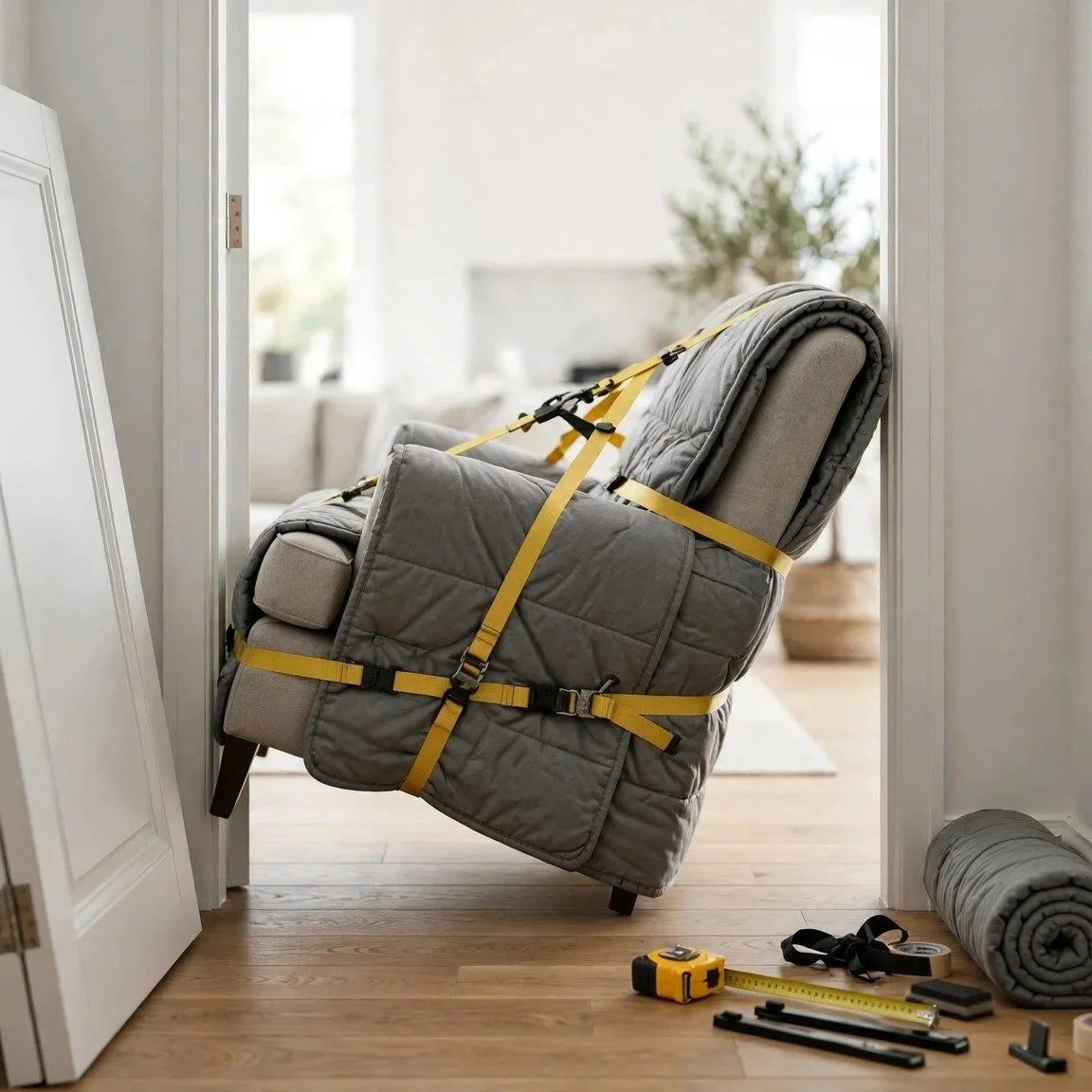
A dresser that slides across an open floor can stop dead in a doorway, and strength is rarely what solves it. Geometry is. A doorway is a fixed rectangle, and the piece you are carrying almost never meets it square. The trick is knowing which measurement actually decides the outcome, then changing the shape of the load, or the shape of the opening, until the two agree. Get the numbers first, and the lift becomes calm and short. Skip them, and you gouge the jamb, crack a foot, or pin a finger against the stop.
QUICK ANSWER: Measure the piece's width, height, and diagonal, then the doorway's true clear width with the door open and the approach on both sides. Take off the door and its hinge pins to gain an inch or two, then strip legs, feet, cushions, and drawers. Most pieces clear at an angle or on one side using a hook-and-turn pivot, or vertically with the L-trick for sofas. When the diagonal still will not fit, hoist it through a window or balcony or take the frame apart.
Why the Diagonal Decides the Job
A doorway looks like a simple width problem, and it usually is not. Furniture is not a flat panel; it is a box with depth, so the number that matters is the diagonal across its face, measured from one corner to the opposite corner. That diagonal is always longer than the height or width alone, which is exactly why a piece that seems too tall or too wide can still slip through once you tilt it and let the long axis run across the opening at an angle.
Most furniture goes through a narrow door one of two ways: turned on its side so its shallowest dimension faces the frame, or tipped to an angle so a corner leads and the diagonal threads the gap. A washing machine behaves as a coin dropped toward a slot: face it flat, and it jams; turn it to match the opening, and it drops through with room to spare. The doorway does not test the piece's size so much as its orientation, and orientation is the one thing you fully control.
There is a second measurement people forget: the approach. A hallway that turns right at the door, or a landing too short to swing a long piece, can stop a load that would clear the opening itself. The tightest point on the whole route is often the turn just before the door, not the door.
Measure Everything Before You Lift
Take the piece's four numbers: Measure width, height, and depth, then the diagonal across the largest face, corner to opposite corner. Write down all four. The diagonal is the figure that tells you whether a tall piece can lean through, and the depth is what matters once you turn it on its side.
Measure the doorway's true clear width: Open the door fully and measure between the door face and the opposite stop, not between the jambs. A swung-open door and its trim can steal an inch or more of the opening you thought you had. Note the header height too, since a piece carried upright has to clear the top of the frame as well as the sides.
Measure the approach on both sides: Walk the route and measure the narrowest hallway, the swing space on each landing, and how much floor you have to angle the piece before and after the door. The "hug" measurement, the tightest wall-to-wall gap anywhere on the path, is your real limit. Compare it against the piece's smallest profile once you have stripped it down.
Make the Opening Bigger
Pull the door off its hinges: A standard interior door and its hinge leaves sit inside the opening even when swung back.
TIP: Tap the hinge pins up and out from the bottom, lift the door away, and you often recover an inch or two of clear width plus the full arc the door used to occupy. That extra room can be the whole difference on a piece that is only a hair too wide.
Take the door stop off if you need more: The thin strip of trim nailed to the jamb, the stop, can be pried away carefully to reclaim another fraction of an inch on a truly tight fit. This is a last resort before disassembly, and the stop goes back with the same nails once the piece is through.
Shrink the Load
Strip the removable parts: Take off everything that adds width or catches on the frame: legs and feet, sofa cushions and back pillows, dresser and cabinet drawers, shelves, table leaves, and any knobs that stick out. A dresser without its drawers is lighter, shorter, and far less likely to shift mid-lift. Bag the hardware and tape it to the underside of the piece so it travels with the furniture.
Protect the frame and the piece: Before anything moves, pad the door jamb and any tight corner with moving blankets held on with tape or stretch wrap, and wrap the leading edges and finished faces of the furniture the same way. Padding buys you clearance you can afford to lose against a soft surface, and it keeps a graze from becoming a gouge on either the wall or the wood.
WARNING: The most common doorway injury is a finger pinched between the piece and the jamb, so keep hands off the frame side of the load entirely and put one person on watching the fingers at the frame. Lift with your legs and a straight back, never take on a piece you cannot control through the full move, and stop the instant anyone loses their grip or their footing.
The Techniques That Get It Through
The hook and turn: For a tall piece such as a bookcase, armoire, or refrigerator, tip the top toward the doorway so the upper corner enters first, then rotate the base to follow as the top clears. This "hook" leads with the diagonal and lets the long dimension pass through on a slant that no straight-on push could manage. One person guides the leading corner while the other controls the pivot at the base, and the piece walks through in a smooth arc rather than a series of shoves.
The L-trick for sofas: A sofa that will not go through flat often clears when stood on end. Tip it up so its back is vertical, and it makes an L or a tall narrow shape, then feed it through with the seat leading, rotating gently as the far arm comes around. The vertical stance turns the sofa's length into height, which most doorways have to spare, and its depth becomes the only dimension the frame has to accept.
Sliders and lifting straps: Furniture sliders under the feet let you position a heavy piece precisely at the door without dragging it or scarring the floor, so the carriers can set the exact angle before they lift. Forearm-forearm lifting straps redistribute the weight to the strongest muscles and free your hands to steer, which is safer than a bear hug on a piece you cannot see around. Lift with your legs, keep your back straight, and never take on a load you cannot control through the full move.
When It Truly Will Not Fit
Sometimes the diagonal is simply larger than the opening, and no angle, stripped part, or removed door will change that. Do the clearance math before anyone strains a back. If the numbers say no, there are two honest paths. The first is a hoist: pass the piece through a wide window or over a balcony rail using straps and a spotter, which turns a blocked doorway into an open span. The second is disassembly: unbolt a bed frame, separate a sectional at its clips, or take the top off a table so the pieces clear individually and reassemble on the far side. Both are ordinary parts of the trade, not signs of failure.
Heavy and awkward furniture is safer with a trained crew who move it every day, carry the right straps and sliders, and can read an opening at a glance. A team lift only works when everyone agrees on the plan before the weight comes up: name who leads, who follows, who calls the pivot, and who watches the fingers at the frame. Count the lift out loud, move slowly through the tight point, and stop the moment anyone loses their grip or their footing.
Frequently Asked Questions
How much clearance should furniture have to pass through a doorway?
Aim for at least two inches of margin between the piece's smallest stripped profile and the door's true clear width, measured with the door removed. That gap absorbs the padding, the carriers' knuckles, and the small wobble any lift has. Under an inch of margin means you are relying on perfect technique with no room for error, which is when jambs get gouged.
Can I remove an exterior door to fit something through?
Exterior doors usually have security hinges with non-removable or set-screw pins, and many are hung on heavier three-hinge frames, so pulling one is slower and sometimes not possible without tools. A slab exterior door can also weigh over 80 pounds, enough to need two people to set it aside safely. When the front door is the bottleneck, a window or patio-slider route is often faster than fighting the entry.
Should I move the heaviest furniture first or last?
Move the largest and heaviest pieces first, while the space is clear and the crew is fresh. An empty room gives you the full approach and swing room a tight doorway demands, and fatigue later in the day is when grip slips, and corners get rushed. Small boxes and lamps fill the truck around the big items once the hard geometry is done.
What if the furniture fits the door but not the hallway turn?
A piece can clear the opening and still jam at a right-angle turn in the hall, because the turn tests the diagonal of the whole piece against the diagonal of the corner. Stand the item on end to shorten its footprint through the turn, or route it back out and try a different door. A folding metal ruler held flat across the corner shows you the true swing arc before you commit the weight.
Do refrigerators and washing machines need special handling in a doorway?
Yes. A refrigerator should be moved upright or tipped no more than about 45 degrees, and it needs to stand for several hours before being powered on if it was laid down, so the compressor oil resettles. Both appliances usually have adjustable leveling feet that thread in to shave off up to an inch of height, and an appliance dolly with a strap holds the load stable through the pivot.
How do I protect a tight door frame from damage during the move?
Wrap the jamb in a moving blanket held with painter's tape, which lifts cleanly and does not pull paint, and add a corner guard or a folded towel at the strike side where most scrapes happen. For a truly tight fit, back the padding with a thin piece of cardboard so a hard corner slides across it rather than digging in. Keep fingers off the frame side of the piece entirely, since a pinch point at the jamb is the most common doorway injury.
Book a crew that reads the doorway before they lift — no scuffed walls, no cracked feet. Aardvark Movers serves Phoenix and the Valley. Call (602) 716-5555.


