
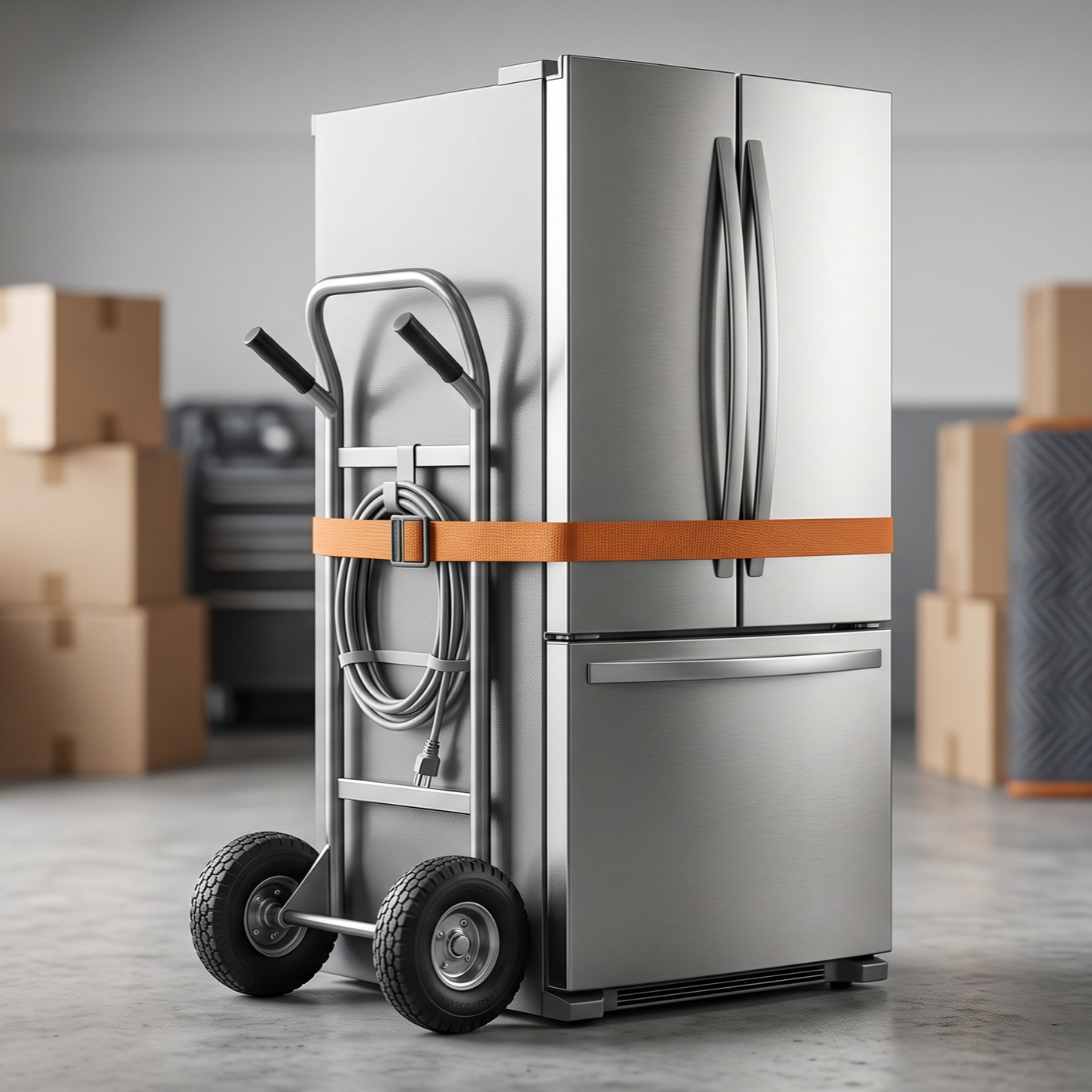
The refrigerator is the appliance everyone underestimates. It looks like a big box on wheels until you try to tip it away from the wall and feel all three-hundred-odd pounds of it fight back, top-heavy and awkward, with a power cord and a water line still tethering it in place. This is the item that turns a smooth-moving day into a wrenching back and a scratched floor.
Whether you should move it yourself or hand it off comes down to two things most people never think about: what is inside the sealed system, and what is between the fridge and the truck.
Why a Fridge Is Not Just a Heavy Box
A refrigerator hides a sealed loop of refrigerant and a compressor in an oil bath. When the fridge stays upright, that oil stays where it belongs. Tip the unit onto its side or its back, and the oil can migrate out of the compressor and up into the refrigerant lines. Stand it up and power it on too soon after that, and the compressor can pump oil where coolant should be, damaging itself.
That is the rule that catches DIY movers off guard. If a fridge has to be laid down at all, it needs to stand upright for hours before it is plugged back in, so the oil drains back to where it started. Many manufacturers say to let it stand roughly the same amount of time it spent on its side, and a good default is to leave it upright and unplugged for several hours, longer if it traveled flat.
What Moving It Yourself Actually Requires
Moving a fridge without damage is a real procedure, not a grab-and-go. Done right, it means emptying and defrosting it a full day ahead so it is dry and not dripping, disconnecting and draining the water line for an ice maker, and securing the doors shut with a strap so they cannot swing open on the stairs. It means an appliance dolly, not a furniture one, plus straps to lock the fridge to it, and at least two able people to control the weight on any slope or step.
Skip a piece of that, and the failure modes line up quickly: a dropped corner that dents the door, a swung-open door that catches a wall, a scratched floor from dragging, a tweaked back from lifting a top-heavy load, or a water line that soaks the kitchen because no one shut it off first.
Defrost and dry the freezer at least 24 hours before moving day. A fridge moved while still frosted drips meltwater through the truck and into other boxes, and a wet appliance sitting in summer heat is an invitation for odor and mildew inside the sealed cabinet.
When Doing It Yourself Makes Sense
A self-move is reasonable when the conditions are forgiving. Ground-floor to ground-floor, wide doorways, a short flat path to the truck, a proper appliance dolly on hand, two or more people who can safely handle the weight, and a fridge light enough and simple enough to manage. On a single-level move across town with the right gear, a careful team can do it without drama.
When to Hand It Off
Bring in a crew when the path fights you or the stakes rise. Stairs are the big ones, because a top-heavy fridge on a staircase is where injuries and dents happen. Tight turns, narrow apartment hallways, a long carry, a built-in or oversized unit, a long-distance haul where the fridge will ride for hours, or simply no dolly and no second strong back all tip the decision toward hiring. In hot weather, there is one more factor: wrestling a heavy appliance in triple-digit heat is hard on a body, and a trained crew that stages the load and paces the work is the safer call.
| Lean toward DIY when… | Lean toward hiring when… |
|---|---|
| Ground floor to ground floor | Stairs on either end |
| Wide doorways, short flat path | Tight turns or narrow halls |
| You have an appliance dolly + straps | No proper dolly available |
| Two or more able helpers | You would be lifting shorthanded |
| Local move, fridge rides briefly | Long-distance or built-in unit |
Protect the Floors, the Doorways, and Yourself
A refrigerator is heavy enough to damage more than itself. Before it moves, lay floor protection along the path, because a loaded appliance dolly will gouge a wood floor or tear vinyl if a wheel catches. Measure the doorways and the fridge before you start, not while holding the weight on a stair, so a half-inch problem does not surprise you mid-lift. Remove the doors from their hinges only if the manual allows it and you truly need the clearance. And pace yourself in the heat: lifting a top-heavy load while overheated is where people get hurt, so hydrate, take the corners slowly, and set it down if the weight starts to get away from you.
Frequently Asked Questions
How long should a fridge sit before I plug it back in?
If it stayed upright the whole move, a couple of hours is a safe cushion. If it was laid on its side or back at any point, let it stand upright and unplugged for several hours, ideally for about the same length of time it spent lying down, so the compressor oil can settle back. Powering it up too early is the mistake that damages the compressor.
Can I move a refrigerator on its side?
It is best avoided, but if there is truly no other way, keep the time on its side for a short while, then let it stand upright for hours before powering it on. Laying it down risks migrating oil into the refrigerant lines. Upright is always the safer orientation for transport.
Do I need a special dolly for a refrigerator?
Yes, an appliance dolly, which has a taller frame and a strap to secure the load, not a standard furniture dolly. The strap locks the top-heavy fridge to the dolly, preventing it from tipping as you tilt it back and roll it. Trying to move a fridge on a flat furniture dolly is how they topple.
What do I do about the water line for the ice maker?
Shut off the water supply to the line, disconnect it, and drain it before the move so it does not leak in the truck or the kitchen. Cap or bag the fitting, and plan to reconnect it at the new place. Forgetting this step is a common cause of flooding a floor on moving day.
Is it safe to move a full refrigerator?
No. Empty it completely, then remove or secure loose shelves and drawers, and defrost it. A loaded fridge is heavier, the contents shift and spill, and glass shelves can crack. An empty, dry, strapped fridge is far lighter and safer to handle.
How many people does it take to move a fridge?
At least two, and more if there are stairs or a long carry. One person cannot safely control a top-heavy appliance on any incline, and a slip with that much weight causes injuries and damage. If you cannot field two able helpers, that alone is a reason to hire a crew.
The System Inside Decides as Much as the Stairs
A refrigerator move succeeds when you respect both the machine and the route. Empty and dry it ahead of time, keep it upright, strap it to a real appliance dolly, and let it rest before it runs again. If the path has stairs, tight turns, or a long haul, or if you would be short a person or a dolly, that is the day to hand it off rather than risk your back and your floors.
When the heavy, awkward pieces are more than a DIY afternoon, a trained crew makes the difference. Aardvark Movers handles appliances, furniture, and full households across Phoenix and the Valley, with the right equipment and no nickel-and-diming. Call (602) 716-5555 for a free quote.


