
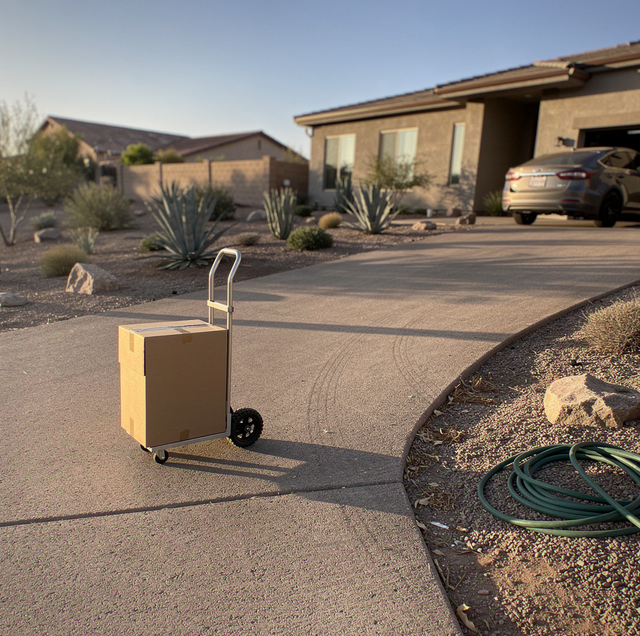
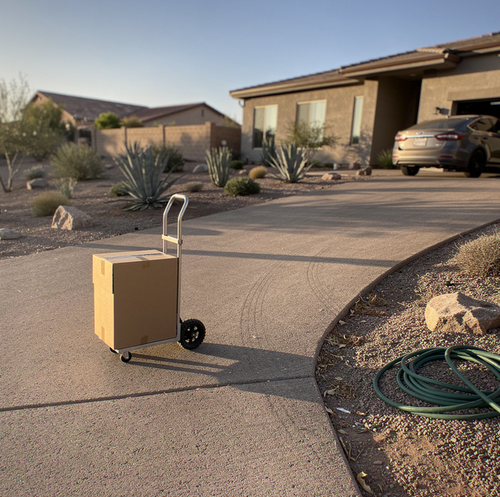
Two households packing an identical three-bedroom house into the same-size truck can still land on different moving days, and the difference comes down to where the truck can park once it reaches your street and how far the crew has to carry everything from that spot to your door. Movers call that distance a long carry, and in some cases the gap grows wide enough, or the street narrow enough, that a second, smaller truck has to take over partway through. Several ordinary access situations turn a short carry into a long one, and each changes the walking distance and the crew's approach in its own way:
| Access Situation | What It Does to the Carry | When a Smaller Truck Takes Over |
|---|---|---|
| Gated community with a guard gate or narrow interior streets | Truck may park outside the gate instead of at the curb | When interior streets, the gate or a community truck rule stop the main truck |
| Low clearance at an entrance or parking structure | Truck cannot enter the property at all | Yes, unless a carry-on foot from outside the entrance is short enough |
| Narrow street or a tight cul-de-sac | Truck parks farther down the block | Only if no legal spot exists close enough to the door |
| A community rule limiting truck size or length | Truck is restricted to a designated lot | Yes, when the rule caps the truck below the size the load needs |
| A long or steep driveway | Truck stays at the street; the carry runs uphill or across distance | Sometimes: a drive the main truck cannot climb or turn in either stays a carry on foot or gets a smaller truck run up it |
| Condo with a loading area set apart from the building | Assigned loading zone sits away from the unit | Sometimes: when the walk from the assigned zone runs long, a smaller truck permitted closer to the unit can take over |
| Townhome reached through a courtyard or walkway | No vehicle access reaches the door at all | No: it is a longer carry on foot, not a second truck |
| A lane with low branches or a weight-limited crossing | Truck cannot physically pass the obstruction | Yes: the obstruction blocks the route entirely |
Where a Long Carry Is Measured From
A long carry is measured from wherever the truck can legally and physically park; on an open street with no restrictions, that spot and the curb are the same thing. Add a gate, a size limit, or a lane that's too narrow to pass, and the truck's actual parking position shifts away from your door before a single box is lifted. That gap between "where the truck sits" and "where the front door is" is what a long carry measures: the path between two fixed points.
This is also why a home can look easy on paper and still carry a long distance in practice. A house set well back from the street, reached by a curving driveway, creates the same walking distance as a gated entrance a few streets over, even though nothing about the property looks restricted from the curb. The trigger is the path's length.
What a Longer Carry Changes on the Day
The clearest effect of a long carry is time per trip. A dresser crosses a long driveway the same number of times it would cross a short one, but each crossing takes longer, and that difference repeats for every item on the truck. Boxes that ride two or three at a time on a short, flat walk get split into smaller stacks where the path turns uneven, since a stacked hand truck can tip on rough ground.
Path protection changes with the distance too. A short carry needs a runner at the door and maybe a turn in a hallway. A long carry means protecting the whole route: a driveway, a walkway, a stretch of lawn, wherever the path runs, and the crew lays that protection before the first item moves rather than as they go. Crew size for that carry is its own separate question from the distance itself, decided by the load and the layout, not by the length of the walk alone.
When the Truck Cannot Reach at All: The Shuttle
A long carry stretches the walk; a shuttle replaces part of the truck. When the street, the gate, the clearance, or a posted size limit stops the main truck from reaching the property at all, a second, smaller truck stages nearby and runs the load between the main truck and the door in shorter trips. This is a different swap than the one that happens on a long-distance move, where a residential-size truck hands its load to a highway trailer partway through the trip; a shuttle here is about reaching one specific address.
On a shuttle job, the added risk comes from handling: every item that would otherwise go from the house to one truck now goes from the house to a staging point, onto the shuttle, off the shuttle, and onto the main truck: one more lift, one more surface, one more place for a corner to catch.
Why the Same Address Can Need a Shuttle on Delivery and Not on Pickup
An access situation is not fixed to the address the way a street name is. A driveway that was open for loading on pickup day can be blocked by a resident's parked car, a delivery truck, or a work crew on delivery day, and a spot that would have let the main truck in has to be checked again rather than assumed. A gate code that worked for one visit can be changed by the time the truck returns weeks later on a longer move. Even the truck itself can differ between the two ends of a trip, since a different carrier or local crew may handle the delivery leg.
That is what makes the constraint easy to miss when a move is first booked: the delivery address can be harder to check from a distance than the pickup. Confirming access at both ends keeps a shuttle from turning into a surprise on moving day.
Photos of the access path read best when taken from the spot where the truck will park, walking toward the front door, so each gate, step, and turn appears in the order the crew meets it.
Details to Pass to the Mover Before the Day
A handful of details, gathered before the truck is scheduled, are what let a mover plan around a long carry instead of discovering it on-site. Gate codes and any community rule about truck size or length belong on that list, along with where the truck is permitted to park and any clearance that could stop it: a low branch, a parking structure ceiling, or a narrow crossing. If your building has its own paperwork for a loading dock or lift reservation, that process runs separately between you, your property manager, and your mover, and it is worth starting early. Photos of the path from parking spot to door round out the picture and catch details a phone call alone can miss.
Parking permits and any posted truck restrictions are set by your HOA, your property manager, or your city, not by the mover, so confirming them with whichever of those applies to your address is worth doing before moving day rather than after a truck is turned away. The same goes for a fire lane or a road the truck cannot legally block: that is a matter for local rules, checked in advance, not worked out with a parking sign on the morning of the move.
A child or pet crossing a long carry path can end up under a loaded dolly, and an appliance hand-carried down a steep drive can run away from a helper; the crew moves heavy pieces on that grade.
Frequently Asked Questions
Is a long carry the same thing as a flight of stairs?
No. A long carry is horizontal distance between the truck and the door, and stairs are a separate, vertical access factor counted on their own. A move can have one, the other, both, or neither, and a mover tracks them separately because they change the crew's route in different ways: one adds distance, the other adds landings and elevation.
Does every apartment or condo automatically need a shuttle?
No. A ground-floor unit or a building with direct street access does not trigger one on its own. A shuttle is tied to whether the truck can physically reach the building, not to whether a property is an apartment or a condo.
Does a long carry change the equipment the crew brings?
Yes: dollies and hand trucks with wheels suited to the surface the path crosses, whether pavement, pavers, or lawn.
Who decides that a move needs a shuttle: you, or the crew on the day?
The call is made in advance from the access details on the move plan, and a crew that arrives to find the street blocked or a gate malfunctioning can still call for one on the spot. That is one reason the pre-move access questions matter even for a property that looked easy to reach on paper.
Does a long carry affect a small load the same way it affects a full house?
The distance itself stays the same either way, but a small load crosses it fewer times. The same access constraint adds less time on a handful of boxes and a few pieces of furniture than it does on a full household's worth of items making the same trip.
Does "shuttle" mean your things arrive on a different day than planned?
Not by itself. A shuttle changes how the load reaches the door; the delivery date is the one set when the move is booked.
Reserve a residential moving crew planned around your home's access — the parking spot, the gate, and the path to the door worked into the move plan. Aardvark Movers serves Phoenix and the Valley. Call (602) 716-5555.


