
An office move is not a bigger version of a household move. A house move pauses your life for a weekend; an office move interrupts a business that still has invoices to send, calls to take, and payroll to run while half its desks are sitting in a truck. It also happens inside two buildings that were never consulted about your timeline, the one you're leaving and the one you're moving into, and each one has its own freight elevator, its own loading dock schedule, and its own property manager with final say over when trucks are allowed at the door. A checklist built for a house doesn't touch any of that.
An office move needs the kind of structure any complex, timed operation needs: a schedule everyone can see, a loading window that's actually reserved rather than assumed, a hard deadline before the next commitment lands, and specific people assigned to specific tasks so nothing sits waiting on someone who already left. The building doesn't stop being used by every other tenant just because your truck showed up. This checklist works backward from move day, because that's the order building requirements and internal deadlines actually stack up against each other.
The Office Move Timeline at a Glance
| Phase | What Slips If This Phase Is Skipped |
|---|---|
| Eight weeks out | Zone labeling and IT staging start two weeks out with no accurate inventory or floor plan to work from |
| Four weeks out | Move week arrives with no elevator, dock, or building sign-off, so equipment sits waiting on a reservation nobody made |
| Two weeks out | Move day and the first day back run blind, with no zone map or cable-to-workstation record to follow |
| Last week | Keys and access cards for the old space go untracked, so no one can confirm which credentials still work in either building |
| Move day | Reconnection has no order to reverse, so IT ends up matching cables and devices to workstations from scratch |
| First day back | Nothing further in the schedule depends on it; unresolved items just become the new office's normal until someone circles back |
These intervals are a typical planning runway, not a fixed rule: a six-desk office can compress it, and a multi-floor buildout usually needs more lead time. The order the phases run in, not the week count attached to each one, is what actually keeps a move on schedule.
Eight Weeks Out: Inventory and the New Floor Plan
Walk every department and count what actually has to move: workstations, filing cabinets, shared equipment like copiers, and anything living in a server room. Match that inventory against the new space's floor plan and seat assignments while there's still time to catch any mismatches, such as a department that's grown since the floor plan was drawn. Decide early which furniture is staying with the business and which isn't; that decision drives labeling later, so it shouldn't slide into moving week. Flag anything needing special handling now, too: safes, copiers, and server racks, so the crew can plan the right equipment, ramps, rated dollies, and corner protection, instead of discovering the need at the door.
Four Weeks Out: Building Requirements, Elevator and Dock Reservations
Both buildings' property management set the real deadline on this phase, not your preference.
Certificate of insurance: Most commercial buildings require a certificate naming the building, and often its management company, as an additional insured before any moving trucks or crew are allowed on site. Request this from your mover early, since the underwriting can take a few business days.
Freight elevator reservation: Buildings running a single freight car typically book it in scheduled windows, and a full office load can fill every open window for a week, so reserve the elevator before you lock the move date, not after.
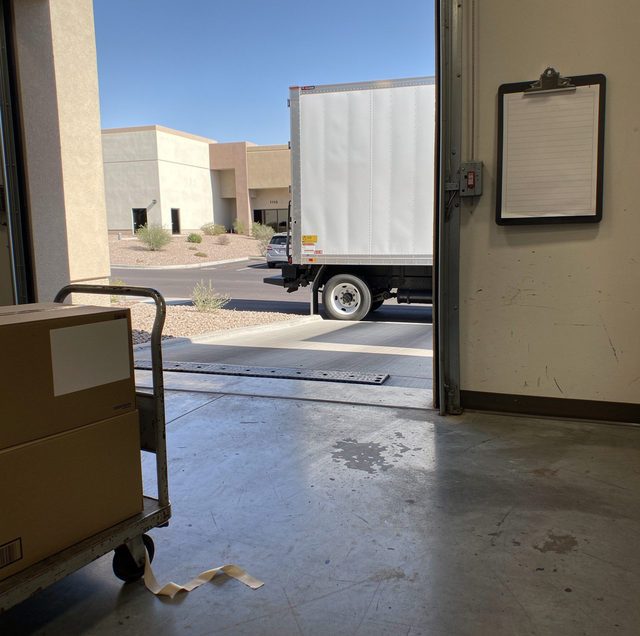
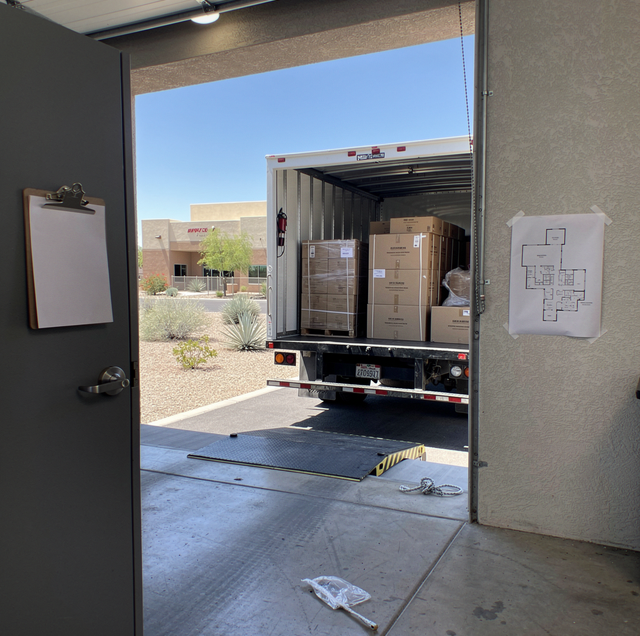
Loading dock time slot: The dock is shared with deliveries for the whole building, so your movers get an assigned block rather than open access whenever the truck arrives.
Move-in hours: The new building may restrict move traffic to specific hours to keep the lobby and elevators clear for other tenants; confirm those hours before telling your team when to expect desks set up.
Floor and door protection: Ask whether the building requires Masonite panels on finished floors and jamb protectors on any doorway the crew will pass through with equipment, since some property managers won't release the elevator or dock reservation without proof of it. This is also the point to notify clients, vendors, and delivery services of the new address and the move date, so invoices, shipments, and mail stop arriving at a building you're about to leave.
TIP: Some buildings charge the freight elevator window to the tenant regardless of whether the crew uses the full block. If loading runs long, the overage is booked as a second reserved window rather than as an extension of the first.
Two Weeks Out: Labeling Zones and Staging IT
Numbered zones: Assign every room and workstation cluster in the new space a zone number keyed directly to the floor plan, then label boxes and furniture with that number rather than a department name alone, since a number survives a last-minute floor plan change better than a name does.
Workstation disconnect and reconnect sequencing: It should record which monitor, dock, and set of peripherals belong to which workstation before anything is unplugged, in the order that matches how the crew will carry equipment out, so reconnecting doesn't turn into a matching exercise.
Cable bagging: Power and data cables get bagged and labeled by zone number and equipment ID rather than tossed loose into a box, so no cable has to be traced back to its device by trial and error. Server room equipment gets its own disconnect plan, separate from ordinary desks, worked out directly with the crew handling it.
The Last Week: Decommissioning and Access
Decommission punch list: Before the last box leaves, walk the old space against a written punch list: patch phone and data jacks, confirm nothing is left behind in a supply closet or break room cabinet, and photograph each room for your own record before keys change hands.
Chain of custody for keys and access cards: Track who holds every key and access card for both buildings during the transition, with a signed log for cards issued to movers or facilities staff and a matching log for cards returned or deactivated; a lost card is a security problem at exactly the moment your business has a footprint in two buildings at once. Confirm which access transfers on move day and which one lags a day behind while old credentials get deactivated.
Move Day: The Load-In
Move day runs on the schedule set weeks earlier: everyone works from the same plan, the loading door is only open for the window you reserved, and items come out of the old space in the order that matches how they'll be set down in the new one, not whichever box happens to be nearest the truck. The moving crew handles heavy and high-value equipment: safes, copiers, and server racks get lifted, wrapped, and moved by the crew, not by staff trying to help.
WARNING: Loaded dollies and heavy equipment belong with the moving crew, not staff. Freight elevators have posted weight limits, and riding one with an overloaded dolly risks the equipment, the car, and anyone standing nearby.
Confirm ahead of time who's authorized to sign for delivery at the new building and who stays behind to confirm the old space is fully empty before the dock reservation window closes.
The First Day Back: Reconnection and the Punch List
The first morning in the new space is a checklist of its own, not a victory lap. IT works the reconnect sequence in reverse order from how it was disconnected, matching each bagged cable set to its zone number and confirming every workstation reaches the network before anyone sits down at it. Anything flagged as damaged, missing, or placed against the wrong spot on the floor plan goes on a new punch list for the moving crew to address, separate from the old space's decommission list. Zones that turned out to need adjustments once furniture was actually in the room, not just drawn on paper, will be resolved this week instead of left half-finished.
Frequently Asked Questions
Does every desk need its own individual label, or can departments share one?
A colored dot sticker layered on top of the zone number, one color per floor or wing, lets crew members sort boxes at a glance from across a room before reading a single label closely. Put the label and dot on the top of the box and on one side, not just the top, so a box that ends up stacked in the truck is still readable without anyone having to shift it first.
What happens to paper files and old records during the move?
Moving crews relocate files; they don't destroy them. If records need to be shredded rather than moved, schedule a separate certificate-of-destruction pickup with a document-destruction vendor ahead of move week, since that service runs on its own calendar and isn't part of a moving crew's scope.
Can the move happen outside normal business hours?
Many buildings allow it, but after-hours access typically requires a security escort or an on-site building engineer, and that person must be scheduled directly with building management as a separate line item, separate from the freight elevator reservation. Skip that step and a crew can show up to a locked door with no one authorized to let them in, even with the elevator already booked.
Who is responsible for the condition of the space being left behind?
Many landlords schedule a surrender walkthrough before keys are returned, during which the condition of walls, carpet, and fixtures is noted before the space changes hands. What a specific lease requires for repairs like anchor holes from mounted monitors, whiteboards, or shelving is a question for the lease and the landlord, not something this checklist can answer; get that patch-and-paint work quoted as its own job, separate from the moving crew's scope.
What happens to furniture that isn't going to the new space?
Furniture staying behind doesn't have to go to a landfill. A separate liquidation or donation pickup, scheduled outside the moving crew's timeline, can clear it out, and a donation receipt or certificate from the receiving organization is worth requesting for the business's records.
What if the new floor plan isn't finalized when boxes need to be labeled?
Assign undecided items to a temporary hold zone number instead of delaying labeling for the whole office. Items in a hold zone get placed in a staging area on move day and reconciled to a permanent zone number once the floor plan question is settled, rather than stalling everyone else's move.
Put your office move on one crew's schedule — from the freight elevator reservation to the last box in the new space. Aardvark Movers serves Phoenix and the Valley. Call (602) 716-5555.


