
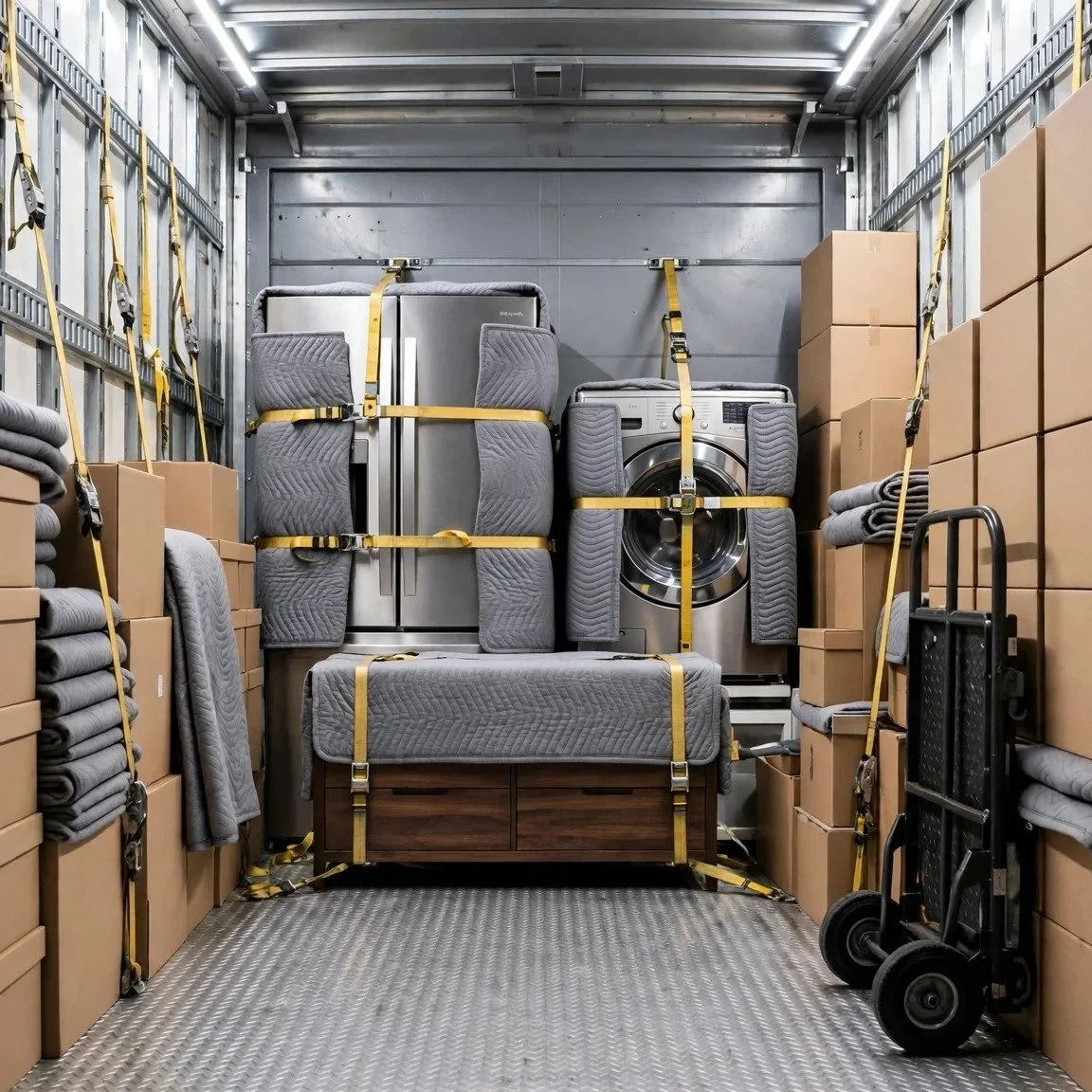
A well-packed truck is less like a stuffed closet and more like a brick wall: every layer bears on the one below it, the load leans against a solid backstop, and nothing has room to wander once the wheels start turning. That mental image explains almost every rule that follows, so it is worth holding onto before you carry the first box up the ramp.
QUICK ANSWER: Load a moving truck in vertical tiers running front to back, starting at the cab wall. Put the heaviest, largest items (appliances, dressers) against the front wall first, stand sofas and mattresses on end along the side walls, and build each tier floor to ceiling with heavy pieces low and light ones high. Fill every gap so nothing slides, pad and wrap surfaces, and strap each tier to the wall hooks before starting the next. Keep weight balanced side to side and a little forward, and save an essentials zone for the very back so it comes off first.
Why Loading in Tiers and Balancing Weight Comes First
Before the first item goes in, understand what you are building. A moving truck is packed as a series of vertical walls, called tiers, that run from the front (the wall behind the cab) toward the rear door. You build one tier tight and floor-to-ceiling, tie it off, then start the next one against it. Each finished tier becomes the backstop for the one behind it, so the whole load braces itself.
Weight distribution is the other half of the principle. Heavy things belong low and forward. Low, because a high center of gravity makes the box sway on turns. Forward, because the truck tows and handles best with slightly more weight over the front axle than hanging off the tail. A truck loaded tail-heavy pushes the rear around on braking and can lift weight off the steering; a truck loaded evenly side to side won't lean into every curve. Getting these two ideas right (tiers front to back, heavy low and forward) is what keeps the load from shifting, and a shifting load in transit is a genuine driving hazard, not just a dented dresser.
Disassemble the Big Furniture First
Anything that comes apart should come apart before it reaches the ramp. Take the legs off tables, remove headboards and footboards from bed frames, pull out dresser drawers if that makes a piece lighter to carry, and detach the cushions from sectionals. Keep the bolts and small hardware for each piece in a labeled zip bag taped to the underside of the frame so reassembly at the new place is not a scavenger hunt.
Disassembly does two things. It shrinks bulky pieces into flat, stackable shapes that pack far more efficiently, and it removes the fragile, snap-prone parts (thin legs, glass inserts, protruding knobs) that break when a piece gets wedged into a tight tier. A flat headboard slides neatly along a side wall; an assembled bed frame eats a quarter of the truck and rides badly.
Load the Heaviest Items Against the Front Wall
The first tier, tight against the cab wall, is for your heaviest and largest items: the refrigerator, washer and dryer, stove, and the big case pieces like a solid dresser, china cabinet, or bookshelf. These anchor the entire load low and forward exactly where the weight belongs.
WARNING: A loaded refrigerator or a solid dresser causes the worst crush injuries and back strains of any moving day, so never hoist one from a bent crouch or carry it alone. Walk it up on an appliance dolly with at least two people, lift from the legs with a straight back, and take the ramp slowly since it becomes a slip and fall risk when wet. Strap a tall appliance to a wall hook the moment it is standing so it cannot tip while you load around it.
Stand upright pieces so their flat backs face the walls and their weight sits squarely on the floor. Set the very heaviest item on the floor, never on top of another piece.
Stand Sofas and Mattresses on End Along the Walls
Long, flat items ride best vertically. Stand a sofa on one arm along a side wall, and stand mattresses and box springs on edge against the opposite wall or flat against a finished tier. On end, a sofa occupies a footprint the size of a single cushion instead of sprawling across the floor, which frees the whole center of the truck for stacking.
Slip the couch into a sofa cover or wrap it in furniture pads before it goes vertical, because the arm now bears the weight and rubs the wall. Mattresses do best inside a mattress bag; standing them on edge keeps them from being crushed flat under a stack, which is what ruins the springs and foam.
Build Each Tier Tight, Floor to Ceiling
With the anchors in place, fill the space above and beside them into a solid vertical wall. The order within a tier repeats the whole truck's logic in miniature.
Heavy on the Bottom, Light on Top: Sturdy boxes packed with books, dishes, or tools form the base of each tier. Same-size boxes stack into a stable column, so pack in uniform cartons wherever you can. Medium boxes go in the middle, and the lightest boxes (linens, lampshades, pillows, that half-empty bag of clothes) crown the top near the ceiling. Never set a heavy box on a light one; the light one crushes and the tier leans.
TIP: Pack in same-size, uniform cartons wherever you can. Matching boxes stack into a stable column that holds its line, while mismatched ones leave gaps and lean, so a tidy carton run is worth more than it looks.
Work each tier all the way to the roof before starting the next. Air space at the top of a tier is wasted cubic feet, and worse, it lets the boxes below shift upward and topple when the truck sways.
Fill Every Gap So Nothing Slides
A tight load has no room to move, and movement is what breaks things. Once a tier is up, walk it and find the voids. Soft goods are your filler: pillows, cushions, rolled rugs, blankets, and stuffed duffel bags wedge into the spaces between boxes and around furniture legs.
Tuck padding between any two hard surfaces that touch, so a table edge is not grinding against a dresser corner for two hundred miles. Slide loose flat items, mirrors, framed art, a table leaf, into the gaps beside a mattress or between two sofa backs where they are sandwiched and cannot slide. The goal is a load so snug that if you pushed on it, nothing rocks.
Pad, Wrap, and Strap Each Tier Before the Next
Protection and securing happen tier by tier, not all at once at the end. Drape furniture pads or moving blankets over exposed wood and upholstered faces, then run stretch wrap around the blankets to hold them in place and to keep drawers and doors from swinging open. Stretch wrap goes over the pad, not directly on wood finish or leather, where it can trap moisture and mar the surface.
Tie Off With Load Bars and Straps at the Wall Hooks: Most box trucks have rows of hooks or slots called E-track along the side walls at several heights. As each tier reaches full height, run a ratchet strap or set a load bar across the face of it and anchor to those hooks, cinching the whole wall snug against the tier in front of it. This is the single step that turns a stack of stuff into a braced wall. Strap at more than one height on a tall tier so the top cannot lean out over the bottom. Do this before you start building the next tier, while you still have clear access to the face.
Balance the Load Side to Side and Slightly Forward
Step back every couple of tiers and read the load as a whole. Weight should sit even across the left and right halves of the truck, so pair a heavy piece on one side with comparable weight on the other rather than loading one rail down. Front to back, aim to keep the heavier mass forward of center and lighter cargo toward the rear.
A truck that leans left rides on tilted suspension and handles poorly on turns; a truck loaded heavy in the tail steers light and brakes badly. And no matter how neatly it packs, do not load past the truck's rated capacity. Every truck has a gross weight limit on the door jamb sticker, and an overloaded truck is both illegal and unsafe to stop.
Save a Load-Last, Unload-First Essentials Zone
The last tier, nearest the rear door, is prime real estate for the things you will want first at the new place. Load it last so it comes off first. This is where the box of tools you need to reassemble the beds goes, along with cleaning supplies, a first-night kit, chargers, and anything you would hate to dig for.
Protect Fragile and Awkward Items Here: The rear zone is also the safest home for the awkward, fragile pieces that don't stack into tiers: floor lamps, a mounted TV in its padded box, potted plants, the vacuum. Because they load last and unload first, they spend the least time buried and take the least abuse. Stand a flat-screen TV on edge, never flat, and sandwich it upright between two soft, immovable surfaces. Set houseplants where they won't be crushed, and if the trip is short, they can ride here loose. Keep this zone strapped too; last does not mean loose.
Frequently Asked Questions
What size truck do I actually need for my home?
A rough rule movers use is about 150 to 200 cubic feet of truck space per fully furnished room, though a room packed with books and a piano needs more than a room with a bed and a lamp. A studio or one-bedroom usually fits a 10-to-12-foot truck, a two-bedroom a 16-footer, and a three-to-four-bedroom home a 26-footer. Sizing up one step is usually smarter than making two trips, because a slightly under-filled truck still packs safely if you strap tiers, while an overstuffed small truck tempts you to exceed the weight rating.
Should I rent a truck with a ramp or a liftgate?
For a household move with heavy appliances, a liftgate (the powered platform that raises cargo to bed height) is easier and safer on your back than a ramp, since you roll the dolly on flat and let the platform do the lifting. A ramp is fine for lighter loads and is faster for repeated box trips, but it is a slip hazard when wet and demands careful footing under a heavy dolly. If your move has a fridge and a full-size washer and dryer, the liftgate earns its keep.
How do I keep the truck floor from scratching my furniture?
Lay a clean furniture pad or a sheet of cardboard flat on the truck floor under any piece that sits directly on the deck, especially wood legs and appliance feet. Truck beds are often ribbed metal or rough plywood that gouges finish and grinds grit into upholstery over a long drive. For rolling pieces, a pad under the front tier also keeps a dolly's wheels from marking the deck as you maneuver.
Can I leave clothes in my dresser drawers while loading?
Light, soft contents like folded clothes are fine to leave in solid wood drawers, and doing so saves boxes, but pull the drawers out of the dresser and carry them separately, then reinsert them once the empty frame is standing in the truck. A dresser carried full is far heavier and likelier to rack or crack at the joints, and drawers can slide open on the ramp. Empty anything heavy or breakable (jewelry boxes, tools, glass) before the piece moves at all.
How should I load a truck if I'm towing a car behind it?
When a car trailer or tow dolly is hitched, the front-heavy rule matters even more, because tongue weight from the trailer adds load to the rear of the truck. Shift a little extra mass forward in the cargo box to counter it, and keep the rear tires on the lighter side. Take corners and stops wider and slower than you would with the truck alone, since the combined length swings a longer tail.
What's the difference between furniture pads, stretch wrap, and packing paper?
Each protects against a different threat. Furniture pads (thick quilted blankets) cushion against impact and abrasion and go directly against wood and upholstery. Stretch wrap is a clingy plastic film that holds pads in place, keeps drawers and doors shut, and bundles loose parts, but it is not padding and should never touch a bare finish for long. Packing paper cushions the inside of boxes around dishes and glass. Using stretch wrap where you need a pad leaves furniture unprotected against dents, which is a common and avoidable mistake.
Book a truck-loading crew that packs it tight the first time — save your back and your furniture. Aardvark Movers serves Phoenix and the Valley. Call (602) 716-5555.


