
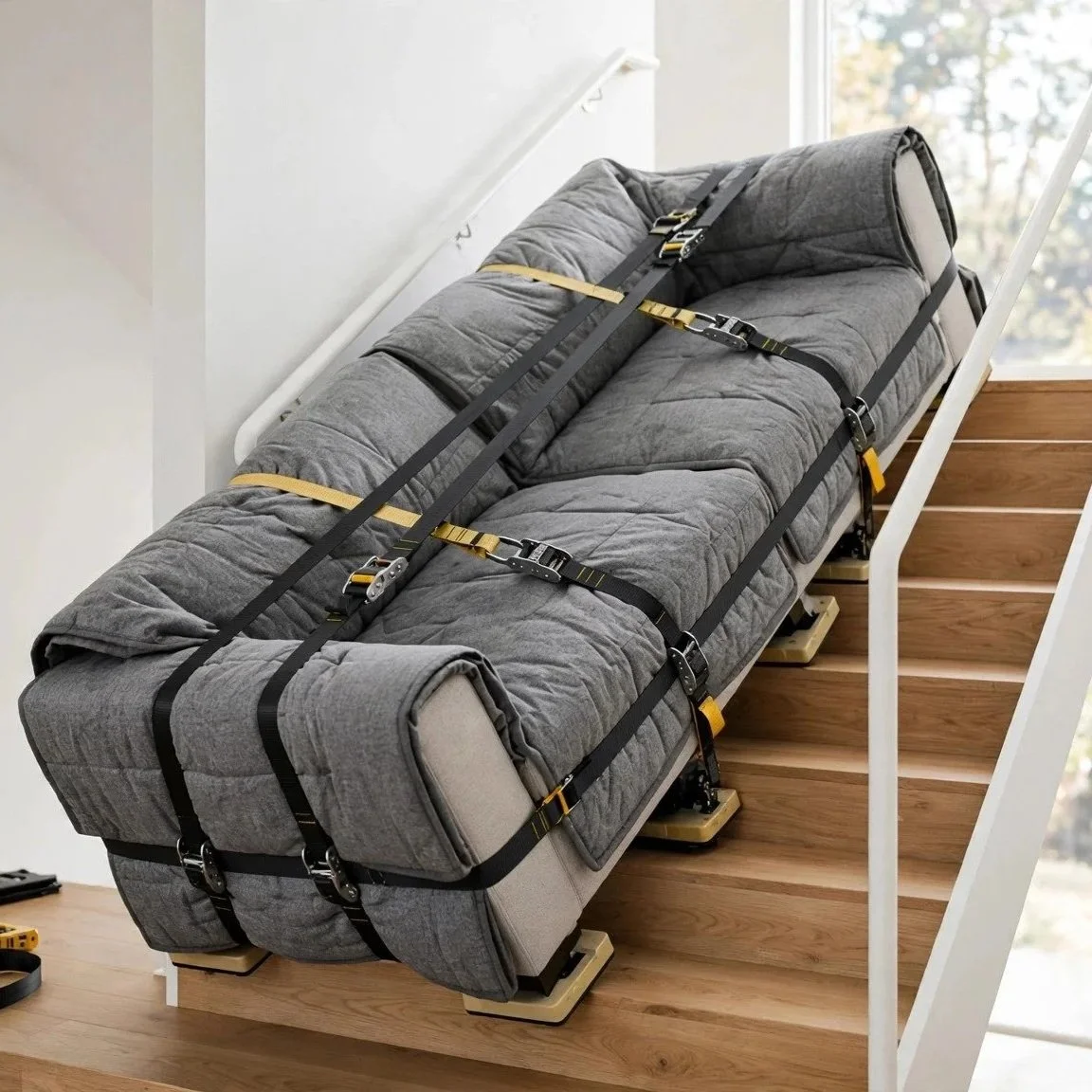
A sofa that slid easily across a living room can wedge itself solid the moment it meets a staircase, and the reason is rarely brute strength. It is geometry. A staircase forces a large rectangular object to change both its height and its angle at the same time, inside a corridor that is often narrower than the sofa is long. Understand how those angles work against you and the job stops being a wrestling match. Get the angles wrong, and you will scuff walls, crack a leg, or pin someone against a railing.
QUICK ANSWER: Measure the sofa's diagonal depth and the stairwell's tightest point first. Strip the legs and cushions, then carry it in the high-low position, back upright, with the person below controlling most of the weight. Pivot at landings using a hook turn. If the numbers say it will not clear a turn, hoist it through a window or take the frame apart before you lift.
Why a Staircase Fights a Sofa
The problem is the diagonal. A sofa is not a flat board; it is a deep box, and the measurement that matters is not its length or its height alone but the distance across its diagonal cross-section, from the top back corner to the bottom front edge. That diagonal is always larger than either single dimension, and it is the number a stairwell actually tests when you tilt the piece to climb.
A staircase also asks the sofa to do two things at once. As you climb, the sofa has to rise, and at any turn it has to rotate. On a straight run that is manageable. At a landing where the stairs switch back, the sofa must swing through an arc while the walls stay put, and the arc it sweeps needs more room than the landing appears to offer. The tightest spot in the whole route is almost always that turn, not the doorway you started at.
Weight distribution is the third force at play. Tilt a sofa nose-up to climb and its center of mass shifts toward the low end, which means the person standing downhill carries far more than half the load. That is the correct arrangement, because the downhill carrier can see the steps and set the pace, but only if that person is braced and expecting it. A sofa behaves like a seesaw with a sliding pivot: whoever is lower on the stairs owns the weight, and the balance point creeps toward them with every degree of tilt.
Measure Before You Lift a Thing
Take the sofa's real dimensions: Measure height, width, and depth, then measure the diagonal depth, which is the straight line from the highest back point to the lowest front point of the frame. Write all four numbers down. The diagonal is the one that decides whether the sofa can rotate through a tight turn on its side.
Measure the route, not just the door: Walk the full path and measure the narrowest point of every doorway, the width of the staircase between walls or between wall and railing, the height of the ceiling over the stairs, and the clear floor space on each landing. The "hug measurement," the tightest wall-to-wall or wall-to-rail gap along the climb, is your true limit. Compare it against the sofa's smallest profile once cushions and legs are off.
Do the clearance math out loud: If the sofa's diagonal is larger than the diagonal opening at a landing turn, it will not swing through no matter how you angle it, and you have found your answer before anyone strains a back. Leave a couple of inches of margin on every number, because knuckles, blankets, and the carriers' hands all need space too.
TIP: The diagonal depth, the straight line from the top back corner to the bottom front edge, is the number that decides a tight turn. Measure it, and if it is larger than the diagonal opening at a landing, the sofa will not swing through at any angle, so you have your answer before anyone strains a back.
Prep the Sofa So It Loses Size and Gains Grip
Strip everything removable: Take off all cushions and set them aside, because loose cushions shift the balance and hide where your hands need to grip. Remove the legs, which usually thread off by hand or with one wrench, and bag the hardware with tape so it rides with the frame. Legs are the most common casualty on a stairwell; they snap when a corner catches, and a sofa without legs is both shorter and less likely to snag.
Wrap for protection, not decoration: Cover the frame in moving blankets and hold them with stretch wrap pulled snug over the fabric; never use sticky tape against upholstery. Add corner guards or extra blanket padding at the front arms and the top back corners, the exact points that will kiss the wall on a pivot. Wrapping also gives your forearms a consistent surface to grip instead of slick leather or loose fabric.
WARNING: On stairs, the person standing lower carries most of the weight, and if the sofa ever gets ahead of them, gravity takes over, and no one controls where it lands. Never take a couch onto the steps that both carriers cannot hold still mid-step, and keep the top end from swinging into a wall or pinning anyone against the railing. If you cannot hold it stationary halfway up, add a carrier or change methods before you lift.
Carry It the Way Movers Do
Use the high-low position: On stairs, one carrier stays low, and one stays high, and the sofa tilts to roughly match the staircase's slope. The low carrier keeps the sofa's weight against their chest and forearms and does most of the lifting from the legs, spine stacked and upright, not bent forward. The high carrier guides direction and keeps the top end from swinging into the wall. Standing the sofa nearly vertical, back upright, shrinks its footprint on the treads and lets both carriers keep their feet under them.
A staircase behaves like a ramp you are feeding a long crate up, and you never let the crate get ahead of the person below it, because once the load outruns its brace, gravity finishes the move for you and nobody controls where it lands.
Lift with legs and keep the load controllable: Bend at the knees and hips, keep your back straight, and lift by straightening your legs. Never take a load onto the stairs that you cannot hold still mid-step, because a staircase gives you nowhere to drop it safely. If the sofa cannot be held stationary halfway up by both carriers, you need more people or a different method, full stop.
Count and communicate every move: Agree on plain commands before you start: "lift," "step," "hold," "down on three." The low carrier calls the pace because they can see the steps and bear the weight. Nobody moves on assumption. One miscounted step on a staircase is how both a wall and a wrist get hurt.
Turn the Corners With a Hook Pivot
Landings are where sofas get stuck, and the fix is the hook turn. As the sofa reaches the landing, the carriers rotate it like the hand of a clock, walking the low end around while the high end pivots in place, so the sofa curls around the corner instead of trying to back straight into a wall. Feed the leading arm of the sofa into the open space first, then swing the trailing end through once the front has cleared.
On a switchback landing, sometimes the sofa must be stood fully on end, one arm pointing at the ceiling, to sweep its diagonal through the tightest arc. This is exactly why you measured the diagonal depth. Move slowly through the pivot, because this is the moment corner guards earn their place and the moment a rushed shove punches a hole in the drywall.
Tools That Make It Safer
Sliders and straps: Furniture sliders under the low end reduce friction on landings and hallway approaches, though they belong on flat runs, not on the treads themselves. Shoulder dollies and forearm forklift straps loop under the sofa and across the carriers' shoulders or forearms, shifting load off the hands and hips and onto larger muscles. On stairs, straps let the low carrier bear weight through the shoulders while keeping both hands free to steady the frame.
Protect the house, not just the sofa: Walls and railings take as much abuse as the furniture. Pad outside corners and railing posts, and consider lifting a spindle-style railing section off if it pinches the path, since a removed railing is cheaper to reset than a cracked one is to replace. Lay a runner or blanket on the treads so a set-down never scuffs the stair nose.
When the Sofa Simply Will Not Fit
Sometimes the numbers lose, and forcing it only breaks something. If the diagonal will not clear the landing arc, stop lifting and switch methods. Many sofas disassemble more than owners realize: backs unbolt from seats, and sectionals separate into pieces that each clear the stairs easily. When the frame is one solid welded unit, the route out is often a window or balcony with a proper rope hoist and a spotter below, a job that is far safer with professional movers who own the rigging and the training. A wide, heavy, or awkward sleeper sofa on a tight switchback is the classic case to hand off rather than risk a fall.
Frequently Asked Questions
How many people do I actually need to carry a sofa upstairs?
Two trained carriers handle a standard three-seat sofa on a straight run, but plan for three the moment a switchback landing or a sleeper mechanism enters the picture. A queen sleeper sofa hides a steel frame and folding mattress that can push its weight past 250 pounds, and that third person works the landing pivot while the other two hold the load steady.
Should the couch go up on its back or on its side?
Lead with it standing on end, one arm toward the ceiling, whenever a turn is tight, because that orientation presents the sofa's narrowest diagonal to the corner. On a wide straight staircase, carrying it seat-forward and slightly tilted is faster. Never carry it flat on its back up stairs, the position that lengthens its footprint across the most treads at once and blocks the carriers' footing.
Will removing the sofa legs actually help, or is it a myth?
It helps twice. Legs typically add two to four inches of height that count against your ceiling and doorway clearance, and their exposed feet are the parts most likely to catch a stair nose or gouge a wall. Loosen them counterclockwise by hand, and if a leg is glued or stapled rather than threaded, leave it rather than pry, since a broken mounting block is harder to fix than a scuff.
What is the safest way to set the sofa down if we need a break mid-staircase?
Rest it on the treads angled along the direction of the stairs, low end down, with one carrier keeping a hand on it at all times so it cannot slide. Never set a sofa flat across the steps as a shelf, because the two-point contact lets it rock and tip. If you cannot find a stable rest point, you took on a heavier load than the staircase allows and should add a carrier before continuing.
Can I use a hand truck or appliance dolly on the stairs?
A stair-climbing dolly with rubber tracks can walk a boxed or tightly wrapped loveseat down a straight flight, but a full-length sofa overhangs a standard dolly badly and becomes top-heavy on an incline. For most sofas, the shoulder-strap carry beats the dolly on stairs. Reserve the dolly for the flat approach and the truck ramp, where its wheels help rather than fight the tilt.
How do I protect a leather sofa differently from a fabric one?
Leather scuffs and creases under pressure that fabric shrugs off, so pad leather with a soft blanket layer first and keep stretch wrap off direct contact with the hide, since trapped plastic can mar the finish or leave a haze in warm conditions. In cold weather, leather stiffens and its surface marks more readily, while summer heat makes it tacky and prone to picking up lint, so wrap the same way year-round and handle the arms and back with extra care whatever the season.
Book a crew that handles the stairs for you — trained movers, padded walls, and no gouged corners. Aardvark Movers serves Phoenix and the Valley. Call (602) 716-5555.


